

Anyone who has waited for a loan approval knows the tension when your documents are under review. You submit your salary slips, bank statements, PAN card, maybe even your rental agreement. Then you wait. What if something’s off? One missing signature or a mismatch in your address can stall the whole deal. For lenders or compliance officers, document verification isn’t just a box-ticking job. Small mistakes can trigger deal fallout, regulatory fines, or even open the door to fraud. The stakes are higher than most people realise.
Where Document Verification Errors Really Hurt Deals
Document verification is a detailed process to confirm the authenticity, accuracy, and compliance of submitted paperwork in finance, banking, and business. Mistakes in document verification – like missing KYC details, mismatched income data, or overlooked forgeries – can cause loan denials, KYC compliance failures, fraud losses, and deal fallout. Getting verification right protects against fraud, ensures regulatory compliance, and prevents costly delays or rejections.
Why Document Verification Matters Beyond Compliance
Document verification isn’t just about ticking a regulatory box. It’s the backbone of fraud prevention, risk management, and trust-building between parties. If you cut corners, you risk much more than an RBI notice or a delayed payout.

-
Regulatory compliance: RBI, SEBI, and other regulators have strict KYC (Know Your Customer) and AML (Anti-Money Laundering) norms. Missing a single detail can lead to penalties or license issues.
-
Fraud prevention: Forged salary slips, fake IDs, and doctored bank statements are common. Rigorous verification weeds out fraudsters early.
-
Error reduction: Manual errors – like misreading a date or skipping a field – can trigger a chain reaction, leading to financial loss or reputational damage.
-
Deal fallout: In M&A, lending, or onboarding, a single unchecked document can collapse negotiations or void a contract.
Honestly, some firms only realise the importance after a costly mistake. Prevention is always cheaper than cure here.
The Document Verification Process Step-by-Step
Every organisation has its own workflow, but the core steps rarely change. Here’s how proper document verification should work:
-
Collection: Gather originals or certified copies of required documents (e.g., Aadhaar, PAN, GST registration, income proofs).
-
Preliminary check: Review for completeness, legibility, and expiry dates. Missing or unclear pages are flagged immediately.
-
Authenticity check: – Cross-verify IDs with government databases (e.g., DigiLocker, UIDAI, NSDL). – Use barcode, QR code, or watermark checks where available.
-
Data matching: Compare information across documents – name, date of birth, address, account numbers.
-
KYC compliance review: Ensure documents meet RBI or SEBI KYC norms (validity, proof type, recentness).
-
Income assessment: For loans or credit, confirm salary slips, IT returns, and bank statements match declared income.
-
Red flag screening: Use automated and manual checks for signs of tampering, forgery, or inconsistencies.
-
Approval or escalation: Pass verified documents to the next stage or escalate if issues are found.
Here’s a simple table contrasting manual vs. digital document verification:
StepManual VerificationDigital VerificationSpeedSlow (hours to days)Fast (minutes to hours)Error riskHigh (manual mistakes)Low (automation, AI checks)Fraud detectionLimited (visual only)Strong (database/API checks)Audit trailPaper-based, hard to trackDigital, easily auditable
Where Most Mistakes Happen (And Why They Cost You)
Mistakes in document verification are rarely about laziness. Usually, they come from:
-
Rushed reviews during month-end or loan season.
-
Unclear guidelines on what counts as valid proof (e.g., older utility bills, e-statements).
-
Tech gaps – using WhatsApp photos instead of scanned originals.
-
Lack of training for staff on new fraud techniques.
-
Overreliance on automation – AI can miss subtle forgeries or context-specific issues.
Common Costly Errors
-
Name mismatches: Even a missing initial or spelling error can halt KYC compliance.
-
Expired documents: Using an old passport or outdated address proof can void an application.
-
Forgery misses: High-quality fakes may slip through if only basic checks are done.
-
Income misreading: Miscalculating average income from inconsistent salary slips or bank statements.
-
Ignoring red flags: Unusual transaction patterns or altered PDFs often go unnoticed in bulk processing.
Each of these can lead to deal fallout, delayed approvals, or regulatory trouble. In some cases, banks have paid crores in fines for KYC lapses – or dealt with massive NPA spikes due to unchecked fake income proofs.
KYC Compliance: What Regulators Actually Require
KYC compliance isn’t just about collecting three documents and moving on. Regulators in India and globally are tightening requirements every year.
RBI KYC Master Directions (India)
-
Customer Identification: Properly verify identity and address using accepted documents (Aadhaar, PAN, passport, etc.).
-
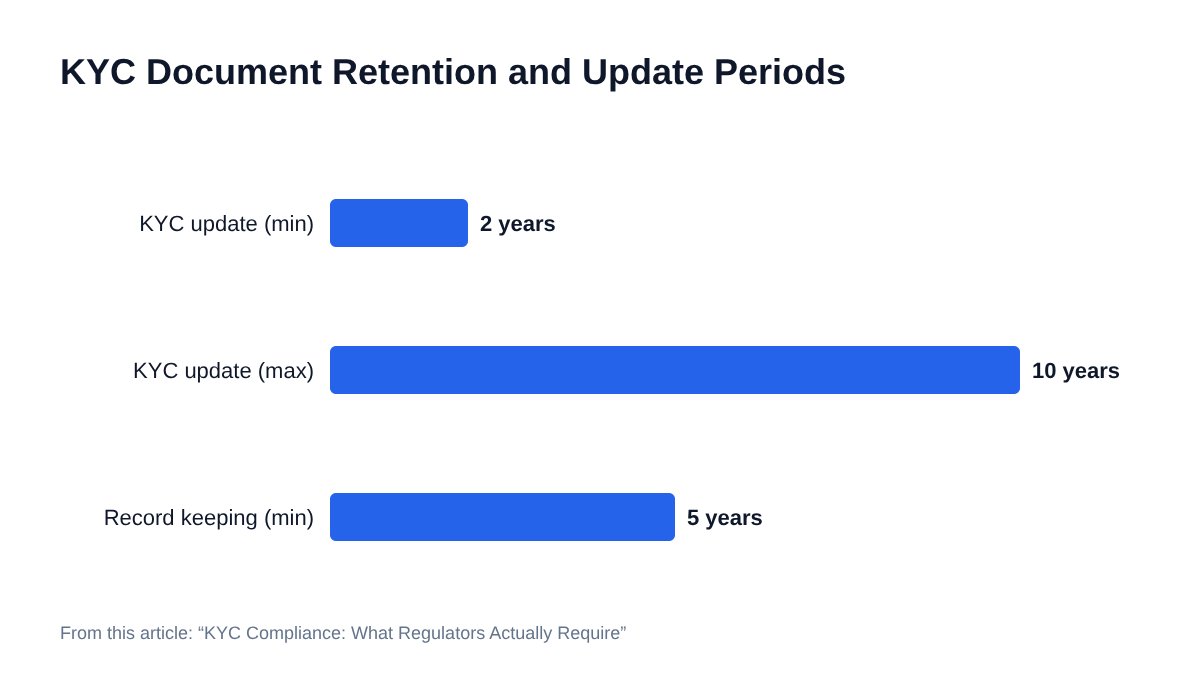
Ongoing due diligence: Update KYC periodically (every 2 – 10 years based on risk category).
-
Enhanced due diligence: For high-risk clients, collect extra documents and monitor transactions closely.
-
Record keeping: Maintain KYC documents for at least 5 years after the end of the business relationship.
-
Reporting: Promptly report suspicious transactions to the Financial Intelligence Unit (FIU-IND).
SEBI and Other Regulators
-
Mutual funds, brokers, and insurance companies must follow similar KYC and AML protocols.
-
CKYC (Central KYC Registry): For financial institutions, integration with CKYC is mandatory to avoid duplication and ensure up-to-date records.
Practical Implications
-
Accept only valid, current documents.
-
Don’t accept e-statements or digital IDs without verifying origin.
-
If in doubt, escalate to compliance or risk teams.
Fraud Prevention Through Document Verification
Fraudsters are always a step ahead. They use:
-
Fake IDs: High-resolution colour prints, morphed images, or even deepfakes.
-
Tampered salary slips: Altered figures, edited logos, mismatched signatures.
-
Synthetic identities: Real PAN with fake name, or vice versa.
Effective Fraud Prevention Steps
-
Use government APIs (e.g., PAN verification via NSDL, Aadhaar authentication via UIDAI).
-
Deploy AI-based forgery detection tools for PDFs and images.
-
Train staff to spot subtle signs – odd fonts, mismatched seals, inconsistent formatting.
-
Cross-check employment details with company HR or public records.
-
Monitor for repeated use of the same documents across multiple applications.
Income Assessment: Why Accuracy Matters
Income assessment isn’t just about seeing a salary slip. Lenders and underwriters need to:
-
Confirm that salary credits in bank statements match payslips.
-
Check for consistency over 6 – 12 months, not just one month.
-
Compare declared income with ITR (Income Tax Return) filings.
-
Watch for salary advances, reimbursements, or one-off credits that inflate actual income.
Example Calculation: Average Monthly Income
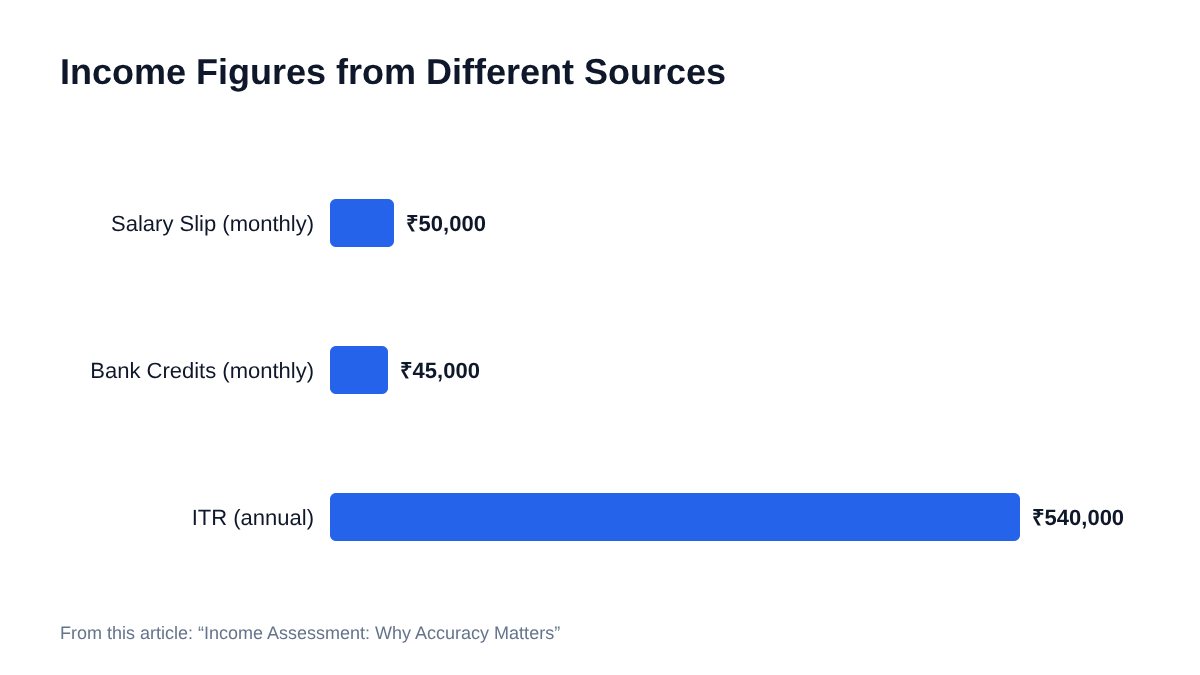
If salary slips show ₹50,000 per month, but bank credits are ₹45,000, and ITR shows annual income of ₹5,40,000 (₹45,000 x 12), there’s a mismatch. Either the applicant is overstating income, or some credits are missing.
- Always use the lowest consistent figure for risk assessment.
Lender Documentation: What’s Required and Why
Banks and NBFCs are required to collect a standard set of documents for loans and credit facilities. Missing or incorrect lender documentation can:
-
Delay disbursal.
-
Lead to loan rejection.
-
Cause compliance issues during audits.
Typical Lender Documentation Checklist
-
Identity proof (Aadhaar, PAN, passport).
-
Address proof (utility bill, rental agreement, voter ID).
-
Income proof (salary slips, Form 16, ITR, bank statements).
-
Business proof (GST registration, trade license, for self-employed).
-
Property documents (for secured loans).
-
Recent photographs and signatures.
All documents should be current, legible, and verifiable. Electronic documents must be downloaded from official sources, not screenshots or photos.
Error Reduction Strategies for Document Verification
No system is perfect, but you can reduce mistakes significantly with a mix of tech and process tweaks.
Use of Technology
-
OCR (Optical Character Recognition): Extracts data from scanned documents, reducing manual entry errors.
-
AI-based validation: Spots anomalies in document patterns, fonts, or metadata.
-
API integrations: For real-time verification with government databases.
Process Improvements
-
Standardised checklists: Prevents missing fields or documents.
-
Double verification: Second-level review for high-value or high-risk cases.
-
Regular training: Update staff on new fraud trends and compliance changes.
-
Audit trails: Keep logs of who reviewed and approved each document.
Sample Error Reduction Checklist
-
Are all documents current and legible?
-
Do names and addresses match across all paperwork?
-
Are government IDs verified via official APIs?
-
Has income been checked against multiple sources (bank, ITR, salary slip)?
-
Are red flags or inconsistencies escalated before approval?
Deal Fallout: Real Costs and Hidden Risks
A single document verification slip-up can cause much more than a lost customer. Here’s what’s really at stake:
-
Regulatory penalties: RBI fines for KYC lapses can run into lakhs or crores.
-
Fraud losses: Loans given on fake documents often turn NPA, hitting the bottom line.
-
Reputation damage: News of fraud or compliance failures can impact share prices and public trust.
-
Operational delays: Every escalation or rework adds days to the process, frustrating customers and partners.
-
Legal disputes: Invalid contracts or agreements can be challenged in court, leading to costly settlements.
Example: RBI KYC Penalty Cases
In 2022, multiple Indian banks were fined between ₹25 lakh and ₹2 crore for KYC documentation lapses, including accepting expired IDs and failing to update customer records. These penalties are public and affect both reputation and compliance ratings.
Digital vs. Manual Document Verification: Pros and Cons
Both methods have their place, but the trend is shifting towards digital for speed and accuracy.
AspectManualDigitalSpeedSlowFastCostHigh (labour, storage)Lower (after setup)Error rateHigher (manual mistakes)Lower (automation, AI)Fraud detectionLimitedStrong (database/API)AuditabilityPoorExcellentRegulatory acceptanceAcceptable, but decliningIncreasingly preferred
Manual checks may still be needed for complex or rare documents, but for most standard cases, digital is both safer and faster.
Regulatory and Accounting Standards: What You Need to Know
India-Specific Regulations
-
RBI KYC Master Directions: Set the baseline for banks, NBFCs, and payment companies.
-
SEBI KYC/AML Guidelines: For brokers, mutual funds, and other market participants.
-
Companies Act, 2013: Requires proper maintenance and verification of statutory registers and records.
-
Income Tax Act: Income disclosures must be supported by verifiable documents during assessments.
-
GST Law: Registration and compliance require valid proofs and regular updates.
Global Standards
-
FATF Recommendations: Global AML standards impacting cross-border transactions and correspondent banking.
-
IFRS/GAAP: Documentation and audit trail requirements for financial statements and disclosures.
Practical Tips for Compliance
-
Keep up with regulatory updates – rules change often.
-
Maintain digital records for at least 5 – 8 years, as required.
-
Use official portals (e.g., GSTN, NSDL, DigiLocker) for document sourcing and validation.
Frequently Asked Questions
What is document verification in banking?
Document verification in banking is the process of reviewing and confirming the authenticity, accuracy, and compliance of documents submitted by customers. This includes checking identity proofs, address proofs, income statements, and other paperwork to meet regulatory and risk requirements.
Why is document verification important for KYC compliance?
Document verification is essential for KYC compliance to ensure that a customer is genuinely who they claim to be. It helps banks and financial institutions prevent fraud, money laundering, and regulatory penalties by validating identity and address details.
What are the common errors in document verification?
Common errors include accepting expired documents, overlooking name or address mismatches, missing forged or tampered documents, and failing to cross-check income details. These mistakes can lead to compliance failures and deal fallout.
How does document verification help with fraud prevention?
Document verification prevents fraud by identifying forged, altered, or fake documents before transactions are completed. Using government APIs, AI-based tools, and manual scrutiny, institutions can catch most fraudulent attempts at an early stage.
What documents are usually required for a loan application?
For a typical loan application, lenders require: – Identity proof (Aadhaar, PAN) – Address proof (utility bill, passport) – Income proof (salary slips, ITR, bank statements) – Business proof (for self-employed) – Property documents (for secured loans)
How can technology reduce document verification errors?
Technology reduces errors by automating data extraction, cross-verifying information with official databases, and flagging inconsistencies or anomalies. Digital systems also maintain audit trails and speed up the verification process.
What penalties can result from poor document verification?
Penalties include regulatory fines (from ₹25 lakh to ₹2 crore in India for KYC lapses), loan losses due to fraud, reputational damage, and operational delays. In some cases, repeated violations can threaten a firm’s license.
How do banks verify income for loan processing?
Banks verify income by cross-checking salary slips, bank statement credits, and ITR filings. Any inconsistencies are flagged for further review or clarification from the applicant.
What is the difference between manual and digital document verification?
Manual verification relies on human review of physical or scanned documents, which is slower and prone to errors. Digital verification uses automated tools, AI, and API connections to verify documents quickly and accurately.
How long should KYC documents be retained?
In India, KYC documents must be retained for at least 5 years after the end of the business relationship, as per RBI and SEBI guidelines. Some institutions keep records for longer periods based on internal policies.
Can e-documents be accepted for compliance purposes?
E-documents are accepted if they are downloaded from official sources and verified through government APIs or digital signatures. Screenshots, photographs, or altered files are not considered valid for compliance.
What should be done if a document appears suspicious?
If a document looks suspicious, escalate it to the compliance or risk team. Do not proceed until the document is verified through additional checks, such as government database queries or direct employer confirmation.
What to Prepare Before Submitting Documents
Before you submit documents for any financial process, double-check for:
-
Correct and current versions of all proofs.
-
Consistency of details (name, address, date of birth) across documents.
-
Legibility – no blurred or cut-off pages.
-
Downloaded e-documents from official sources.
-
All required signatures and seals.
If you’re unsure, ask the receiving institution for their latest checklist. It’s better to fix issues before submission than to deal with deal fallout later.
Document verification is not just a formality. Every field, signature, and stamp matters. Getting it right protects everyone – applicant, lender, and regulator – from avoidable risks, delays, and losses. If there’s ever a doubt about a document, it’s always safer to pause and check than to rush and regret.