

Every Australian lender has felt it: that nagging sense of wasted hours, double-checking figures and chasing paperwork, all because someone typed a date wrong or mixed up a few numbers. Manual data entry in loan origination isn’t just a hassle – it quietly drains money, slows down service, and opens the door to costly errors. For credit teams, operations managers, and compliance officers, the hidden costs of this old-school approach can pile up faster than most people expect.
The Real Price of Manual Data Entry in Australian Loan Origination
Manual data entry in Australian loan origination leads to higher operational costs, increased error rates, compliance risks, and slower processing times. These issues can result in financial losses, regulatory penalties, workflow errors, and poor customer experience. Process automation improves data accuracy, reduces costs, and helps lenders remain competitive and compliant.
Why Manual Data Entry Is Still Common in Aussie Loan Processing
Most Australian lenders still rely on manual data entry for at least some stages of their loan origination process. This is usually because of legacy systems, fragmented data sources, or regulatory requirements that haven’t caught up with digital trends. Sometimes, it’s just habit – “We’ve always done it this way.” But a closer look shows how this approach creates more problems than it solves.
- Legacy core banking platforms often lack seamless integration with new digital tools.
- Many lenders still receive application documents as scanned PDFs or physical forms.
- Compliance checks, like KYC and AML, sometimes require manual review or re-keying data into multiple systems.
- Staff turnover and ad hoc process changes can make automation projects seem risky or expensive.
Honestly, most teams underestimate how much time is spent just moving data from one screen to another. If you’ve seen two people copy-pasting the same figures in different tabs, you know what I mean.
The Direct Financial Impact: Counting the Hidden Costs
Manual data entry doesn’t just waste time. It costs real money, both upfront and over the long term.
Labour and Operational Costs
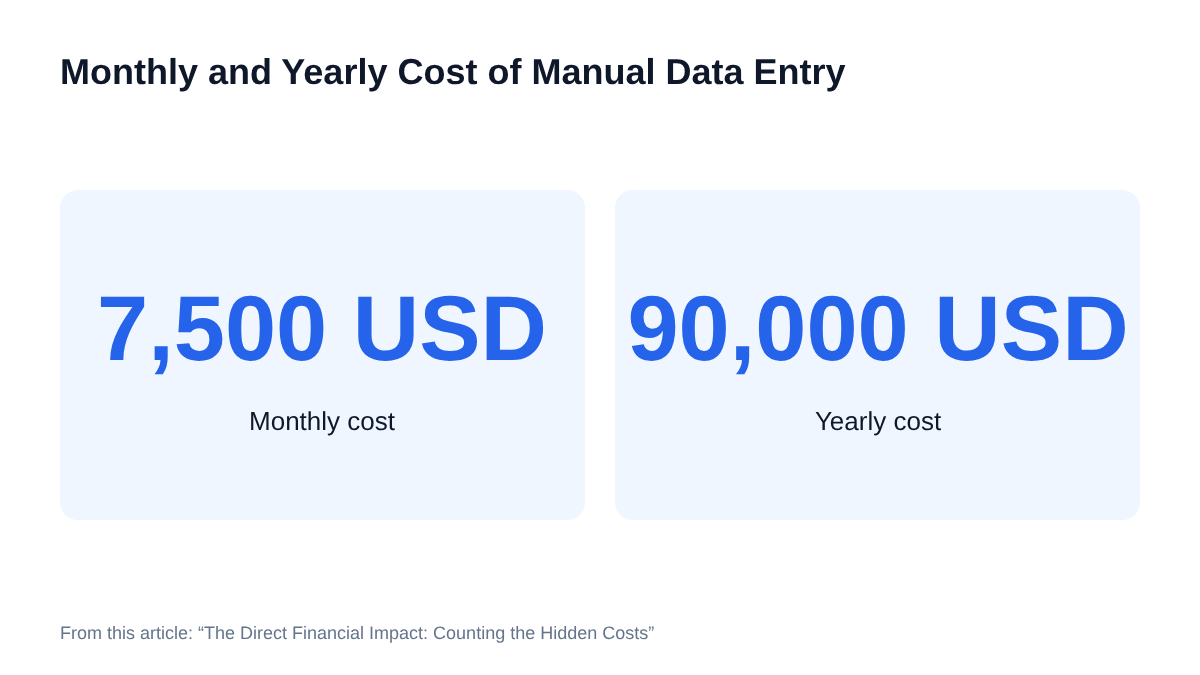
- Wages: Data entry clerks in Australia earn between $25 – $35 per hour. For a mid-sized lender processing 500 applications per month, even half an hour per application adds up to over $7,500 monthly – nearly $90,000 a year.
- Training and Supervision: Mistakes or process changes mean more training and oversight. This adds indirect costs in management time and lost productivity.
- Rework and Corrections: Fixing errors isn’t free. Often, it takes longer to find and fix a typo than to enter it in the first place.
Compliance and Error-Related Penalties
- ASIC and APRA Penalties: Australian lenders are subject to strict reporting and responsible lending rules. Errors in data can trigger regulatory investigations, fines (which can reach hundreds of thousands of dollars), or even licence suspension in severe cases.
- Customer Compensation: If an error leads to an incorrect decision or delay, lenders may have to compensate borrowers under the Australian Financial Complaints Authority (AFCA) guidelines.
Opportunity Costs
- Lost Business: Slow processing due to manual entry can push customers to faster competitors, especially with digital-first neobanks entering the market.
- Delayed Revenue Recognition: Every day a loan sits in the pipeline because of workflow errors is a day of lost interest income.
Error Rates: How Often Does Manual Data Entry Go Wrong?
Typical Error Rates in Loan Origination
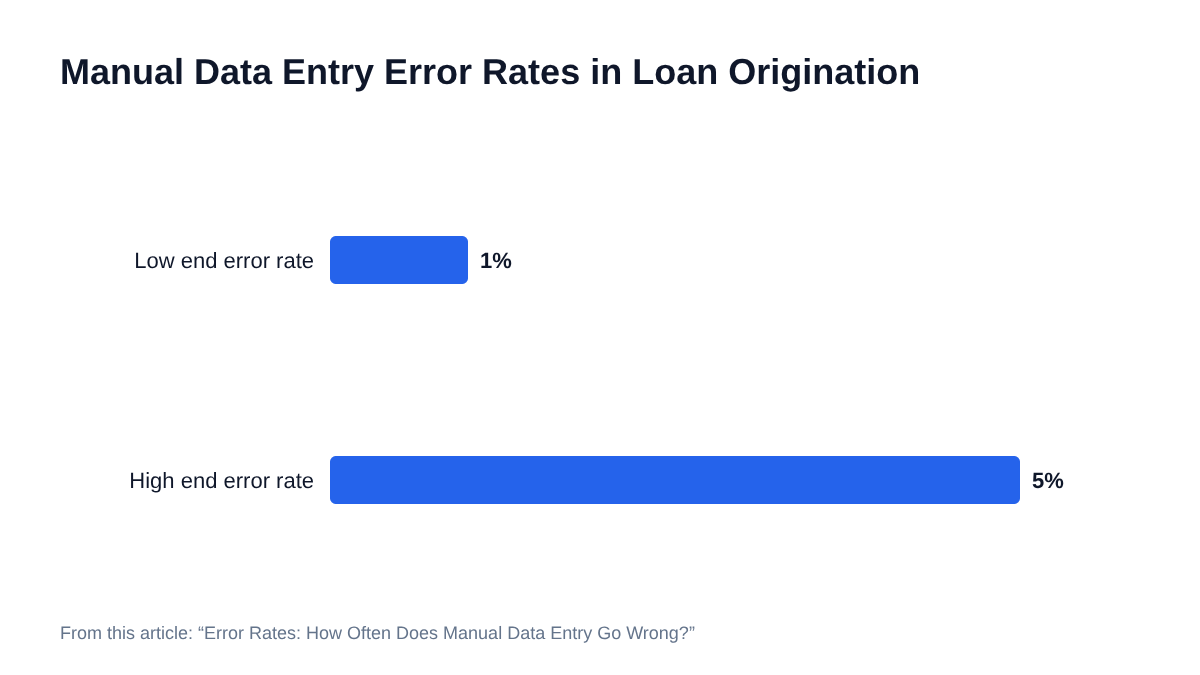
Studies by the Australian Productivity Commission and international data quality benchmarks show that manual data entry error rates hover between 1% and 5% per field. For a standard home loan application with 50 – 100 data fields, this means almost every second file has at least one mistake.
Common Error Types:
- Transposed digits (e.g., loan amount $350,000 entered as $305,000)
- Incorrect customer information (misspelled names, wrong addresses)
- Missed compliance flags (e.g., unchecked PEP or sanctions status)
- Duplicate or missing records
Real-World Example: The Cost of One Mistake
Suppose a $450,000 mortgage application is entered with the wrong interest rate due to a manual error. The loan gets approved, but the customer is overcharged by 0.25%. The lender must:
- Refund the customer (often with interest)
- Report the incident to ASIC
- Investigate and remediate the workflow
- Possibly face a penalty or compensation order under AFCA
The direct cost of such a mistake can run into thousands, not counting reputational damage.
Impact on Data Accuracy, Compliance, and Auditability
Data Accuracy and Integrity
Manual entry makes it hard to ensure that data is complete, consistent, and up-to-date across all systems. Even with regular audits, discrepancies slip through. This affects:
- Credit risk assessment: Inaccurate data leads to poor lending decisions.
- Portfolio reporting: Errors can distort loan book quality metrics.
- Management reporting: Decision-makers act on flawed information, impacting strategy.
Regulatory Compliance and Reporting
Australian lenders must comply with:
- National Consumer Credit Protection Act 2009 (NCCP Act)
- Australian Privacy Act 1988
- Anti-Money Laundering and Counter-Terrorism Financing Act 2006 (AML/CTF Act)
- ASIC’s RG 209 for responsible lending
Manual workflow errors can cause:
- Late or inaccurate submission of APRA and ASIC reports
- Breaches of responsible lending obligations
- Privacy violations due to incorrect customer records
Auditors may flag repeated manual errors as control weaknesses, requiring remediation and sometimes external investigation.
Audit Trail and Traceability
Automated systems create a full digital audit trail. Manual processes often don’t. If a regulator asks, “Who changed this figure and why?”, paper-based or spreadsheet systems rarely have a reliable answer. This increases legal risk and makes compliance reporting much harder.
The Ripple Effect: Workflow Bottlenecks and Customer Experience
How Manual Data Entry Creates Workflow Errors
- Bottlenecks: Applications pile up waiting for review or correction.
- Miscommunication: Data mismatches between teams (credit, compliance, settlement) cause delays.
- Missed SLAs: Service-level agreements (like 48-hour approvals) are hard to meet when paperwork goes missing or needs to be redone.
Impact on Customer Experience
Borrowers expect fast, digital service. Manual data entry slows everything down:
- Delayed approvals frustrate customers and brokers.
- More back-and-forth for missing or incorrect info.
- Errors lead to repeat paperwork, hurting trust.
A 2023 survey by the Mortgage & Finance Association of Australia (MFAA) found that 53% of borrowers would switch lenders for a faster, more transparent application process.
Comparing Manual Data Entry vs. Process Automation
Benefits of Process Automation
- Lower error rates: Automated data capture from digital forms, APIs, or OCR reduces mistakes to below 0.1%.
- Faster turnaround: End-to-end loan origination time can drop from 5 – 10 days to 1 – 2 days.
- Real-time compliance checks: Automated KYC/AML verification reduces regulatory risk.
- Improved data accuracy: Single data entry point, instant validation, and audit logging.
Cost Comparison Table
| Factor | Manual Data Entry | Automated Process |
|---|---|---|
| Error Rate | 1% – 5% | <0.1% |
| Average Processing Time | 5 – 10 days | 1 – 2 days |
| Staff Required (per 100 apps) | 2 – 3 FTE | 0.5 – 1 FTE |
| Compliance Breach Risk | Moderate – High | Low |
| Customer Satisfaction | 3/5 | 4.5/5 |
Why Some Lenders Still Resist Automation
- Upfront investment can be high (software, integration, training).
- Change management is often underestimated.
- Concerns about data migration and system downtime.
But honestly, sticking with manual data entry usually costs more in the long run – both in dollars and lost market share.
Regulatory and Compliance Considerations for Australian Lenders
Key Laws and Standards Affecting Data Entry
- National Consumer Credit Protection Act (NCCP Act): Requires accurate record-keeping for all loan applications and decisions.
- Australian Privacy Principles (APPs): Mandate secure handling and correction of personal data.
- AML/CTF Act: Demands reliable identity verification and reporting of suspicious transactions.
- ASIC Regulatory Guide 209 (RG 209): Sets expectations for responsible lending, including data accuracy and traceability.
- APRA Prudential Standards (e.g., APS 220): Require clear audit trails and robust controls over credit data.
Reporting and Audit Requirements
- Lenders must submit regular reports to APRA and ASIC (e.g., credit activity, responsible lending compliance, suspicious matter reports).
- Inaccurate or late filings can lead to fines, licence conditions, or public censure.
- Auditors typically check for control weaknesses, repeat errors, and the integrity of audit trails.
Penalties for Data Entry Failures
- ASIC can issue fines, require remediation, or impose enforceable undertakings.
- APRA may increase capital requirements or restrict business activities.
- Privacy Commissioner can order correction, compensation, or public apologies for data breaches.
Practical Steps to Reduce Manual Data Entry in Loan Origination
1. Map and Standardise Data Flows
- Document every step where data is entered, copied, or checked.
- Identify duplicate entry points and manual hand-offs.
- Standardise forms and field formats across the organisation.
2. Adopt Digital Origination Platforms
- Invest in loan origination systems (LOS) with electronic forms, workflow automation, and integration to core banking.
- Enable digital document uploads and direct data feeds (e.g., from credit bureaus, ID verification providers).
3. Integrate Compliance and KYC Automation
- Use automated KYC/AML modules with real-time checks and alerts.
- Ensure audit trails are captured at every step for compliance reporting.
4. Train and Upskill Staff
- Shift data entry staff to higher-value roles (e.g., exception handling, customer support).
- Provide training on new systems and compliance requirements.
5. Monitor, Audit, and Refine Processes
- Set up regular data quality checks and workflow audits.
- Use dashboards or exception reports to catch errors early.
- Continuously improve based on feedback and regulatory changes.
Case Example: Manual Data Entry vs. Digital Verification in KYC
A mid-sized Australian lender processed KYC checks manually for over 5,000 loan applications annually. This required three full-time staff, with an average error rate of 2% per application. After switching to digital verification tools (see How Digital Verification Transformed KYC for Aussie Borrowers), they:
- Reduced error rates to under 0.1%.
- Cut processing time from 3 days to under 6 hours.
- Reassigned two staff to higher-value compliance roles.
- Improved audit outcomes, with no major findings in the next APRA review.
How to Calculate the True Cost of Manual Data Entry
Sample Calculation Framework
- Direct Labour Cost
– Number of applications per month × Average time per application × Hourly wage rate - Error Correction Cost
– Number of errors × Average time to fix × Hourly wage rate - Compliance and Penalty Risk
– Estimate based on historical penalties, audit findings, or compensation paid - Opportunity Cost
– Estimated lost revenue from delayed approvals or customer churn
Add these up for a rough annual cost. For most lenders, even a conservative estimate runs into six figures.
Technology and Vendor Considerations
What to Look for in a Loan Origination System
- End-to-end automation: Digital forms, straight-through processing, and integration with core banking.
- Real-time compliance checks: Built-in modules for KYC/AML, PEP, and sanctions screening.
- Data validation and enrichment: Automatic flagging of missing or inconsistent fields.
- Audit and reporting tools: Customisable dashboards, exportable audit trails, and compliance-ready reports.
- Security and privacy compliance: Meets Australian Privacy Principles and APRA CPS 234 requirements.
Vendor Evaluation Checklist
- Proven track record with Australian lenders
- Local support and regulatory expertise
- Flexible integration options (APIs, batch imports)
- Transparent pricing and clear SLAs
- Strong references or case studies
Common Mistakes Lenders Make When Reducing Manual Data Entry
- Underestimating the change management required for staff and brokers
- Failing to map all manual touchpoints before automation
- Choosing systems that don’t integrate with existing platforms
- Neglecting compliance requirements in automation projects
- Not setting up ongoing monitoring or data quality controls
If you want a broader view on digital transformation challenges, see Rethinking Loan Application Processing in Australia: From Compliance to Customer Experience.
Frequently Asked Questions
What is manual data entry in loan origination?
Manual data entry in loan origination means staff input customer, loan, and compliance information by hand, often using spreadsheets or typing into multiple systems. This process is slow, error-prone, and can create compliance risks for Australian lenders.
Why is manual data entry risky for Australian lenders?
Manual data entry increases the risk of errors, which can lead to regulatory breaches, financial penalties, and poor customer experience. It also slows down processing, making it harder to compete with digital-first lenders.
How can lenders reduce manual data entry errors?
Lenders can reduce errors by:
– Using digital forms and direct data capture
– Automating compliance checks
– Standardising data entry fields
– Training staff in data quality best practices
What are the most common workflow errors caused by manual data entry?
Common workflow errors include:
– Duplicated or missing records
– Incorrect customer details
– Inconsistent application data across systems
– Missed compliance checks
How does process automation improve data accuracy?
Process automation uses digital tools and validation rules to capture data directly from customers or integrated sources. This reduces manual re-keying and catches errors instantly, improving overall data accuracy.
What financial regulations affect data entry in Australian lending?
Key regulations include the National Consumer Credit Protection Act (NCCP Act), AML/CTF Act, Australian Privacy Principles, and ASIC’s RG 209. These require accurate records, reliable audit trails, and secure handling of personal data.
What penalties can result from data entry mistakes in loan origination?
Penalties may include ASIC fines, APRA restrictions, customer compensation via AFCA, and privacy breach orders from the Office of the Australian Information Commissioner. Repeated or serious errors can threaten a lender’s licence.
How can lenders calculate the cost of manual data entry?
To calculate costs:
1. Add up direct labour for data entry and error correction.
2. Estimate compliance penalties or compensation paid.
3. Factor in lost revenue from delays or customer churn.
What is the average error rate for manual data entry in lending?
Manual data entry error rates are typically between 1% and 5% per field, based on industry studies. This means almost every file can contain at least one mistake in larger applications.
How does manual data entry affect customer experience?
It slows down approvals, leads to more requests for corrected information, and increases the risk of mistakes that frustrate borrowers. Many customers now expect digital, error-free service.
What should lenders look for in a loan origination system?
Look for systems with end-to-end automation, compliance modules, real-time data validation, strong audit trails, and local support tailored for Australian regulations.
Are there situations where manual data entry is unavoidable?
Some legacy systems or unique customer scenarios still require manual steps, especially if documents are received in non-digital formats. However, most routine processes can be automated with modern tools.
The Bottom Line for Australian Lenders
Manual data entry in loan origination is more than old-fashioned – it’s expensive, risky, and increasingly out of step with what regulators and customers expect. Australian lenders who keep manual processes face higher costs, more errors, and regulatory headaches. The move to process automation isn’t just about cutting costs; it’s about staying compliant, competitive, and ready for the future of lending.