

Banks in Australia are known for their strict processes, but waiting weeks for a simple home loan approval still frustrates customers and brokers alike. Even as banks push flashy apps and digital onboarding, the real work often stalls behind the scenes. Loan approval delays have become a running joke among property buyers, and honestly, nobody laughs. The reasons are deep-rooted – manual paperwork, ancient systems, and risk teams buried in old habits. This isn’t just a tech problem; it’s a tangle of compliance, legacy thinking, and real-world money at stake.
Why Australian Banks Still Face Loan Approval Bottlenecks
Most Australian lenders face loan approval delays because of outdated systems, manual processing, strict compliance checks, and fragmented workflows. Legacy technology, complex regulation, and risk-averse credit decisioning make it hard to automate or speed up approvals. Even large banks with digital apps still rely on slow, manual steps behind the scenes. Fixing these bottlenecks requires process optimization, smarter data use, and a willingness to rethink old habits.
Why Loan Approval Delays Are Still So Common in Australia
Customers expect loans to get approved in days, but real-world waits stretch to weeks or even months. This isn’t just annoying – it can cost buyers their dream home or force businesses to miss out on growth opportunities. The most common reasons for these delays are:

-
Legacy systems that can’t talk to newer digital tools
-
Manual processing of documents, ID checks, and income proofs
-
Workflow bottlenecks where applications pile up at one review stage
-
Compliance checks that are slow and repetitive
-
Risk teams that take a conservative approach to credit decisioning
Australian banks operate in a tough regulatory environment. Every loan must meet strict AML (Anti-Money Laundering), KYC (Know Your Customer), and APRA lending standards. Missing a single checkbox can stall a file for days. Brokers and applicants often get stuck waiting for just one missing pay slip or a signature on an outdated form.
How Manual Processing and Legacy Systems Cause Workflow Bottlenecks
The biggest hurdle is the mix of old and new technology. Most banks still run their core systems on platforms built before smartphones even existed. Even if the front-end looks modern, the back-end is a patchwork of:
-
Mainframe databases
-
Paper-based forms and scanned PDFs
-
Email chains for approvals
-
Spreadsheets for tracking progress
Manual Steps That Slow Down Approvals
A typical home loan application can require up to 15 manual hand-offs:
-
Collecting customer documents (payslips, IDs, statements)
-
Data entry by a staff member
-
Initial credit check
-
Manual review of supporting documents
-
Compliance screening (AML, KYC)
-
Valuation requests
-
Risk assessment team review
-
Approvals from senior staff
-
Document preparation
-
Customer signature collection
-
Final compliance check
-
Settlement team hand-off
-
Funds disbursement
-
Post-settlement review
-
Archiving the file
If even one step gets backed up, the whole process stalls. During peak periods, some banks admit to 1 – 2 week backlogs just in document verification. It’s not rare to see approvals take 15 – 25 days, even for straightforward applications.
Why Upgrading Legacy Systems Is So Hard
Replacing a bank’s core loan processing system is like trying to renovate a house while living inside it. Risks include:
-
Regulatory complications if data is lost or mishandled
-
Cost overruns and missed deadlines
-
Staff retraining and new process rollouts
Many banks try to bolt on new digital layers, but the old core remains. This means any process optimization is limited by what the legacy system can handle. The result? Slick mobile apps on the outside, but slow, manual steps underneath.
The Role of Compliance, Regulation, and Credit Decisioning
Australia’s lending market is shaped by strict rules. Lenders must follow APRA’s Prudential Standard APS 220 (Credit Quality), ASIC’s responsible lending guidelines, and the National Consumer Credit Protection Act. These rules are there for good reasons – protecting borrowers and the financial system – but they add layers of checks:
-
Income and expense verification
-
Third-party credit bureau checks (Equifax, Illion, Experian)
-
Anti-fraud and anti-money laundering screening
-
Ongoing reporting and audit trails
Compliance Checks: A Double-Edged Sword
Every extra rule means another step in the process. For example:
-
APRA requires banks to stress-test a borrower’s ability to repay at higher interest rates.
-
ASIC mandates clear documentation of how a loan is suitable for the customer.
These checks are often done manually, or with systems that can’t fully automate the work. If a rule changes (like the 2021 responsible lending reforms), banks scramble to update hundreds of procedures and forms.
Credit Decisioning: Why Humans Still Dominate
Even with credit scoring engines, most Australian banks still rely on human underwriters for final decisions on complex or high-value loans. Reasons include:
-
Fear of compliance breaches if automation misses something
-
Lack of confidence in data quality
-
The need for judgment in edge cases (self-employed borrowers, unusual income sources)
Automation is growing, but for now, humans are still the gatekeepers for many files.
The Real-World Impact: From Customers to Lenders
Loan approval delays aren’t just a technical problem. They affect real people and businesses:
-
Home buyers lose properties to faster-moving competitors
-
Small business owners miss out on growth or cash-flow relief
-
Brokers spend hours chasing updates and missing documents
-
Bank staff face burnout during peak periods
Case Example: A Sydney Home Buyer
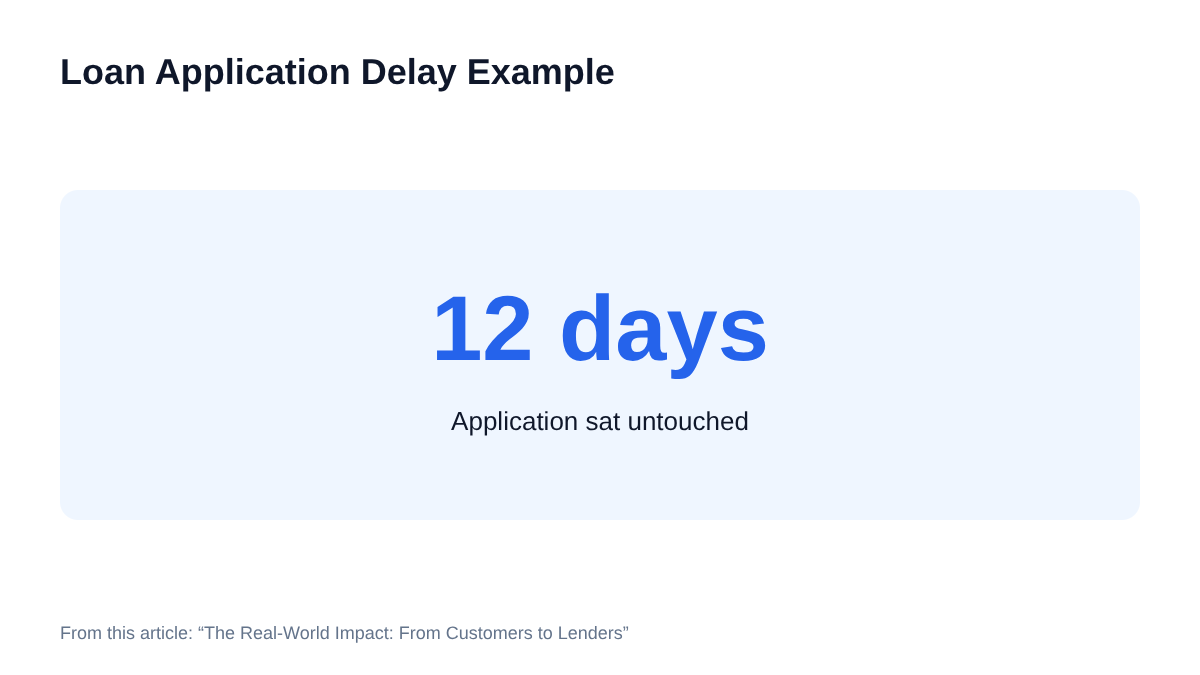
Priya, a first-home buyer in Sydney, applied for a mortgage with a major bank. She uploaded all documents through the app, but her application sat untouched for 12 days. The hold-up? Her employer’s letter had a minor typo, and the system flagged it for manual review. By the time the loan was approved, the seller had accepted another offer.
Impact on Banks’ Bottom Line
-
Lost business: Customers may walk away if approval takes too long.
-
Increased costs: Manual work means higher staff expenses.
-
Compliance risk: Rushed approvals can lead to audit failures and fines.
Common Loan Processing Challenges for Australian Banks
Australian lenders face a unique mix of challenges that make fixing approval delays tricky.
Fragmented Workflows
Many banks still use different systems for each loan type (home, car, personal, business). This leads to:
-
Duplicate data entry
-
Lost or mismatched documents
-
Different approval processes for each product
Data Quality Issues
Poor data is a hidden enemy. Common issues include:
-
Incomplete applications
-
Mismatched names and addresses
-
Outdated credit files
Banks often need multiple follow-ups just to get the right information, adding days to the process.
Staff Training and Turnover
Many approval steps depend on experienced staff. High turnover or under-trained staff can cause:
-
Errors in data entry or compliance checks
-
Slow escalation of complex files
-
Missed deadlines on settlements
Technology Integration Gaps
Banks that acquire smaller lenders or bolt on fintech tools often struggle to integrate everything. This causes:
-
Double handling of information
-
Incompatible file formats
-
Confusion over who owns each step
Process Optimization: What Works, What Doesn’t
Banks have tried dozens of ways to speed up loan approvals. Not all work as promised.
Successful Tactics
-
Pre-populating applications with existing customer data
-
Automated document collection and verification (e.g., OCR, biometrics)
-
Real-time status updates for brokers and applicants
-
Centralized workflow dashboards to spot bottlenecks
What Often Fails
-
Relying only on digital front-ends without fixing the back-end
-
Over-automating complex credit decisions
-
Ignoring change management and staff training
Table: Manual vs Automated Steps in Loan Processing
StepManual ProcessingAutomated ProcessingDocument CollectionEmail, paper, in-branchMobile upload, API feedsData EntryStaff inputPre-fill from bank recordsCredit ChecksManual bureau requestsReal-time API checksCompliance ScreeningStaff reviewAutomated rules engineApproval NotificationPhone/email by staffInstant SMS/email

Regulatory and Accounting Considerations
APRA and ASIC Requirements
Banks must comply with:
-
APRA Prudential Standard APS 220: Sets out requirements for credit risk management, including documentation and ongoing review of loan portfolios.
-
ASIC Responsible Lending: Under the National Consumer Credit Protection Act, lenders must make reasonable inquiries into a borrower’s requirements and objectives, and verify their financial situation.
-
AML/CTF Act: Strict anti-money laundering and counter-terrorism financing rules require detailed customer verification and reporting of suspicious transactions.
Failure to comply can lead to:
-
Regulatory fines (up to AUD 10 million or more for major breaches)
-
Enforceable undertakings
-
Damage to reputation and loss of customer trust
Accounting and Reporting Implications
Under IFRS 9 (Financial Instruments), banks must:
-
Recognize loan assets and expected credit losses appropriately
-
Monitor and report on credit quality and impairment
-
Maintain audit trails for all credit decisions
Delays or errors in loan processing can impact financial reporting accuracy, audit outcomes, and capital adequacy requirements.
Practical Steps for Compliance
Banks should:
-
Maintain clear, up-to-date loan policy manuals
-
Regularly train staff on regulatory changes
-
Invest in audit-ready workflow systems
-
Conduct periodic reviews of credit files and approval processes
Technology Solutions: What’s Changing (and What Isn’t)
Australian banks are investing heavily in technology to tackle bottlenecks, but progress is uneven.
Digital Lending Platforms
Banks are rolling out end-to-end digital lending systems that promise quicker approvals. Features include:
-
Automated ID and document checks
-
API integration with credit bureaus
-
Digital signatures and e-settlement
But these systems often run in parallel with old platforms, leading to confusion and double-handling.
Artificial Intelligence and Machine Learning
AI is being used for:
-
Fraud detection
-
Income verification from bank statements
-
Predictive credit scoring
However, AI models need high-quality data. Most banks are still cleaning up their old records before AI can be trusted for core decisions.
Open Banking and Data Sharing
The Consumer Data Right (CDR) allows customers to share their banking data with lenders and fintechs. This can:
-
Speed up income and expense verification
-
Reduce the need for manual document collection
-
Enable faster credit decisioning
But adoption is still low, and many customers are wary of sharing sensitive data.
What Can Banks Do to Reduce Loan Approval Delays?
There’s no magic fix, but banks can make real progress by:
-
Mapping every step of the approval process to spot bottlenecks
-
Standardizing forms and checklists across all products
-
Automating repetitive compliance checks where possible
-
Training staff to handle exceptions efficiently
-
Regularly reviewing policies to match current regulation
Banks should also benchmark their approval times against industry averages and use customer feedback to target the worst pain points.
For a deeper look at how Australian banks are rethinking their loan application processes, see Rethinking Loan Application Processing in Australia: From Compliance to Customer Experience.
Frequently Asked Questions
What causes loan approval delays in Australian banks?
Loan approval delays are usually caused by manual processing, legacy systems, strict compliance checks, and fragmented workflows. These issues can slow down every stage, from application to settlement.
How long does a typical home loan approval take in Australia?
A standard home loan approval can take anywhere from 7 to 25 days, depending on the lender, the applicant’s situation, and the bank’s internal processes. Delays are common during busy periods or when extra documents are needed.
What is manual processing in loan approvals?
Manual processing means staff must review, enter, or verify information by hand, rather than using automated systems. This often involves checking documents, making phone calls, or updating spreadsheets.
How do legacy systems impact loan approval times?
Legacy systems are old technology platforms that can’t easily integrate with modern digital tools. They cause delays by requiring manual workarounds, duplicate data entry, or slow data retrieval.
What regulations affect loan processing in Australia?
Key regulations include APRA Prudential Standards (APS 220), ASIC’s responsible lending rules under the National Consumer Credit Protection Act, and the AML/CTF Act. Banks must follow strict procedures to comply with these laws.
Can loan approval delays be reduced with technology?
Yes, technology such as digital document collection, automated credit checks, and workflow management tools can help reduce delays. However, success depends on integrating these tools with core banking systems and updating internal policies.
What is credit decisioning and why is it important?
Credit decisioning is the process of assessing a borrower’s ability and willingness to repay a loan. It involves reviewing credit history, income, expenses, and other risk factors. Accurate credit decisioning protects both the bank and the customer.
What steps are involved in a typical loan approval process?
A typical process includes: 1. Application submission 2. Document collection 3. Data entry 4. Credit assessment 5. Compliance checks 6. Approval 7. Settlement Each step may involve manual or automated work.
What is process optimization in banking?
Process optimization means improving how work is done to reduce delays, errors, and costs. In loan processing, this can involve automating tasks, streamlining workflows, and removing unnecessary steps.
Why do banks still use manual processing?
Banks often rely on manual processing because of legacy systems, regulatory requirements, and the complexity of some loan applications. Not all steps can be automated, especially for unusual or high-risk cases.
How does compliance checking slow down loan approvals?
Compliance checking requires banks to verify customer identity, income, and risk according to strict rules. These checks are often done manually, which can add days to the approval process if documents are missing or errors are found.
What can customers do to speed up their loan approval?
Customers can help by providing complete and accurate documents, responding quickly to requests for information, and checking their credit history before applying. Choosing a lender with digital processing can also reduce delays.
Moving Forward: Breaking the Bottlenecks
Australian banks are under pressure to fix loan approval delays, but progress is slow. Real change needs more than new apps or faster forms. It means rethinking old processes, investing in technology that actually integrates with the core system, and training staff for both compliance and speed. Customers and brokers want faster answers, but banks can’t ignore the risks of getting it wrong. Balancing speed with trust and compliance remains the real challenge. For now, expect some paperwork – and a bit of waiting.