

Australian business owners and professionals know the ATO isn’t just a distant authority – it’s the gatekeeper for every tax, compliance, and reporting decision you make. One missed BAS, a forgotten payroll tax, or a stray figure in your financial statements can mean audits, penalties, or even sleepless nights. Taxation rates, GST Australia, and SMSF accounting can feel like a maze, especially with rules shifting each financial year Australia. Getting your accounting for taxation right isn’t optional. It’s survival.
How the ATO Shapes Australian Taxation and Accounting
The ATO (Australian Taxation Office) is Australia’s main tax regulator, overseeing tax returns, GST, payroll tax, and superannuation compliance for businesses and professionals. Staying compliant with ATO rules is essential – errors can lead to audits, fines, or legal trouble. Accurate accounting, up-to-date knowledge of taxation rates, and timely lodgment of returns are key to managing risk and meeting your business obligations in Australia.
Australian Taxation: The ATO’s Role and Core Compliance Duties
The ATO isn’t just a tax collector – it’s the watchdog for nearly every financial move your business makes. The rules it enforces cover a wide net, from GST Australia to superannuation, and the penalties for getting it wrong are real.
What the ATO Oversees
- Income tax: All companies, trusts, and individuals must submit annual tax returns.
- GST (Goods and Services Tax): Registered businesses must report and pay GST on taxable sales.
- Payroll tax: States and territories levy this on wages above a threshold, but reporting often links back to ATO data.
- Fringe Benefits Tax (FBT): If you provide perks to staff (like a work car), you might owe FBT.
- Superannuation: Employers must pay super and report it through Single Touch Payroll (STP).
Most people underestimate the sheer volume of data the ATO matches – bank feeds, employer STP, contractor ABNs, and more. Don’t assume a small error will slip through.
Key Compliance Touchpoints
- Tax returns: Lodged annually, with strict deadlines (usually 31 October for individuals, later for agents).
- BAS (Business Activity Statement): For GST, PAYG withholding, and other obligations – often quarterly or monthly.
- Single Touch Payroll: Pay event reporting to the ATO every pay cycle.
- Annual financial statements: For companies, trusts, and SMSFs, these must align with tax returns.
Miss one of these, and the ATO can issue penalties, interest, or even initiate audits. Honestly, most trouble starts with late or mismatched reporting.
Taxation Rates, GST, and Payroll Tax: What Businesses Must Know
Australian tax rules look simple at first, but the details trip up even seasoned professionals. Each tax has its own rates, thresholds, and quirks.
Key Taxation Rates and Thresholds
- Company tax rate: 25% for base rate entities (turnover under $50 million), 30% for others (2023 – 24).
- Individual income tax: Progressive, starting at 0% up to 45% for income above $180,000.
- GST: 10% on most goods and services, with some exemptions (basic food, some education, health).
- Payroll tax: Varies by state/territory, usually 4 – 6% on wages over a threshold (e.g., $1.2 million in NSW, $700,000 in QLD).
Example: Company Tax Calculation
Suppose your business has $2 million taxable income and qualifies as a base rate entity. Your tax payable:
$2,000,000 x 25% = $500,000
GST Australia: Registration and Reporting
- Register if your GST turnover is $75,000 or more ($150,000 for non-profits).
- Charge 10% GST on taxable sales.
- Claim credits for GST paid on business purchases.
- Report GST in your BAS (usually quarterly, but monthly if turnover is high).
If you forget to register or miscalculate GST, the ATO will expect back payments plus interest. It’s not worth the risk.
Payroll Tax: State-by-State Differences
Payroll tax is a headache for businesses with staff in multiple states. Each state sets its own threshold and rate. For example:
StateThresholdRateNSW$1.2 million5.45%VIC$700,0004.85%QLD$1.3 million4.75%
You’ll need to register separately in each state where your wage bill passes the threshold. Payroll tax isn’t managed by the ATO, but you must still report wages through STP, which the ATO shares with state revenue offices.
Financial Year Australia: Deadlines, Reporting, and Key Dates
The Australian financial year runs from 1 July to 30 June. This calendar is non-negotiable for most business reporting and tax obligations.
Major Lodgment Dates
- Individual tax returns: Due 31 October (unless using a registered agent, who gets extensions).
- Company/trust tax returns: Usually due 15 May if using a tax agent.
- BAS: Generally due 28 days after the end of each quarter (e.g., Q1 BAS due 28 October).
- Superannuation guarantee payments: Due quarterly, 28 days after each quarter ends.
- PAYG withholding annual report: Must align with STP finalisation (usually 14 July).
Missing a deadline can mean late lodgment penalties, which start at $313 per 28 days late (for small businesses, 2023 – 24 rates) and ramp up fast.
ATO’s Compliance Focus Each Year
The ATO shifts its audit focus regularly. Recent years have seen:
- Work-related expense claims (for individuals)
- Cash economy and undeclared income
- GST fraud
- Superannuation guarantee shortfalls
- Crypto transactions and capital gains
If you work in a sector the ATO is targeting, double-check your records and reporting.
Accounting for Taxation: Best Practices and Common Pitfalls
Good accounting for taxation is about more than ticking boxes. It’s about matching every figure in your financial statements with your tax returns and BAS, so nothing gets flagged.
Aligning Financial Statements with Tax Returns
The ATO compares your financial statements with your tax returns. Discrepancies (e.g., revenue in one but not the other) can trigger an audit. Here’s what to watch:
- Revenue recognition: Make sure sales in your accounts match your BAS and tax return.
- Expense classification: Don’t claim private expenses as business deductions.
- Asset depreciation: Use ATO’s effective life tables for tax depreciation, not just accounting depreciation.
- Stock valuation: The ATO allows cost, market selling value, or replacement value – pick one and stick with it.
Common Mistakes in Tax Businesses
- Incorrect GST claims: Claiming GST on purchases that aren’t eligible (e.g., GST-free supplies).
- Missing PAYG withholding: Not withholding tax from employee or contractor payments.
- Forgetting to register for GST or PAYG: If your turnover or wage bill passes the threshold, you must register.
- Lodging late: Penalties add up, and repeated lateness gets flagged.
Best Practices for Compliance
- Use cloud accounting software: Most now integrate with the ATO for direct BAS and STP lodgment.
- Reconcile bank accounts monthly: Unmatched transactions are a red flag.
- Keep supporting documents: Invoices, receipts, contracts – store them for at least five years.
- Review ATO updates: Tax rates and rules change, often with little warning.
Financial Statements: What the ATO Looks For
Financial statements aren’t just for the bank – they’re the backbone of your tax reporting. The ATO uses them to cross-check income, expenses, and asset values.
Main Financial Statements
- Profit and Loss Statement (P&L): Shows revenue, expenses, and net profit or loss.
- Balance Sheet: Details assets, liabilities, and equity at financial year-end.
- Cash Flow Statement: Tracks cash in and out (not always required, but good practice).
- Statement of Changes in Equity: For companies and trusts, shows owner/shareholder movement.
Reconciliation with Tax Returns
- P&L net profit should match taxable income (after adjustments for non-deductible expenses and add-backs).
- Asset values on the balance sheet should reflect depreciation and write-offs claimed in the tax return.
- Liabilities like GST and PAYG payable must match what’s reported in your BAS.
If the numbers don’t line up, the ATO may request a detailed reconciliation or supporting documents.
GST Australia: Registration, Calculation, and Reporting
GST is one of the most misunderstood taxes. The ATO is strict about registration, calculation, and reporting.
Registration Rules
- Register if GST turnover is $75,000+ ($150,000 for non-profits).
- Failing to register on time means backdated GST liabilities and penalties.
Calculating GST Payable and Credits
- GST on sales: 10% of taxable sales (exclude GST-free, input-taxed supplies).
- GST credits: Claim GST paid on business purchases (not private expenses).
- Net GST: GST on sales minus GST credits = amount payable to the ATO.
Example Calculation
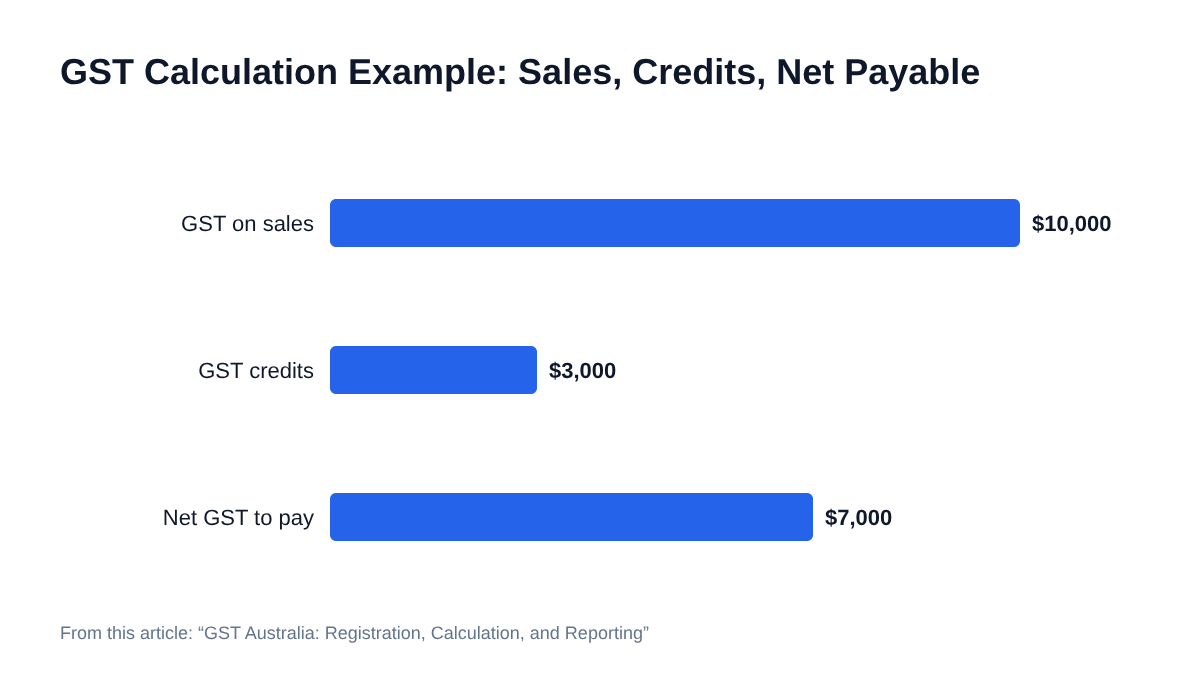
Suppose you sold $110,000 (inc. GST) and spent $33,000 (inc. GST) on eligible purchases:
- GST on sales: $110,000 / 11 = $10,000
- GST credits: $33,000 / 11 = $3,000
- Net GST to pay: $10,000 – $3,000 = $7,000
Reporting and BAS
- Quarterly BAS: Most businesses lodge every three months.
- Monthly BAS: If turnover is $20 million+ or the ATO requires it.
- Annual GST return: Small businesses may use this if turnover is under $75,000 and registered voluntarily.
Mistakes in GST reporting are a top trigger for ATO audits.
Payroll Tax: Obligations, Registration, and Compliance
Payroll tax is managed by state and territory revenue offices, but ATO data (via STP) is increasingly cross-checked. If you pay wages above state thresholds, you must register and pay payroll tax.
Key Points
- Wages include salary, bonuses, super, and some contractor payments.
- Thresholds and rates vary by state.
- Registration is separate for each state where you employ staff.
- Returns are usually monthly or quarterly, with an annual reconciliation.
Common Payroll Tax Mistakes
- Not registering in all relevant states.
- Incorrectly excluding contractor payments.
- Underreporting superannuation or bonuses.
If you get payroll tax wrong, expect back payments plus interest and penalties.
SMSF Accounting: Taxation, Auditing, and ATO Scrutiny
Self-managed super funds (SMSFs) are tightly regulated, with the ATO overseeing both compliance and tax.
SMSF Taxation Basics
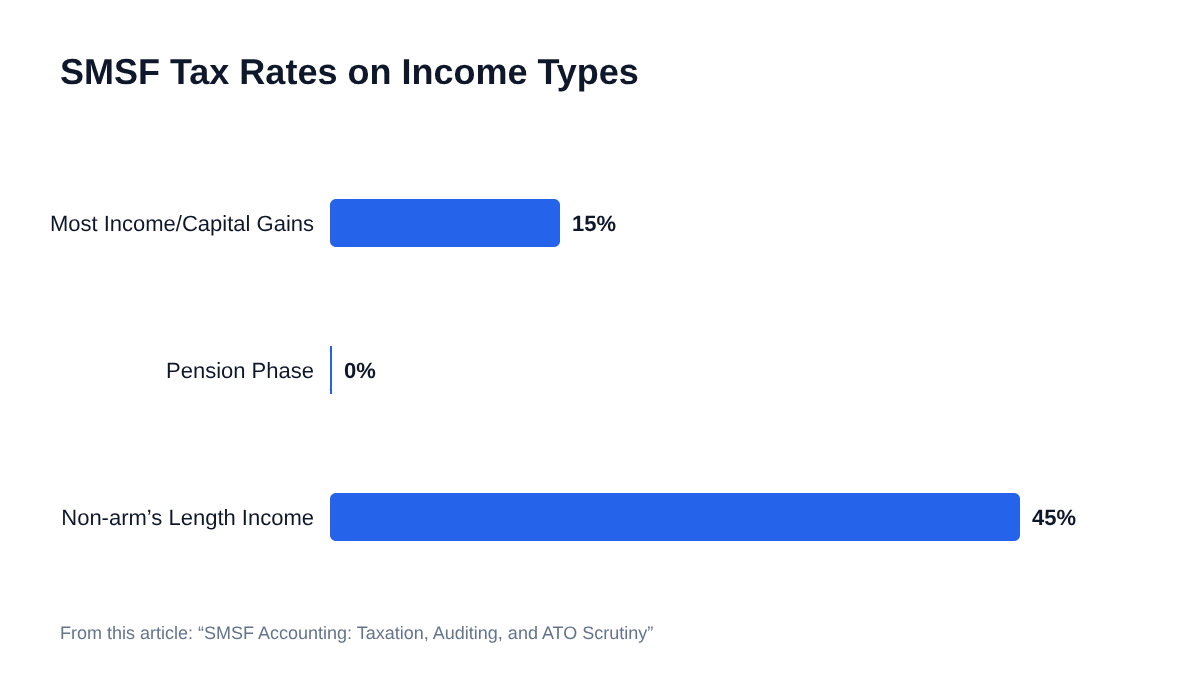
- 15% tax rate on most income and capital gains.
- 0% tax in pension phase for most funds (subject to transfer balance cap).
- Non-arm’s length income is taxed at 45% if the ATO finds related-party dealings weren’t at market value.
SMSF Compliance Requirements
- Prepare financial statements and annual return each year.
- Appoint an independent SMSF auditor.
- Meet investment strategy and sole purpose test.
- Lodge the SMSF annual return with the ATO by the due date.
Common SMSF Accounting Issues
- Late lodgment: Can result in administrative penalties or even loss of fund status.
- Non-compliant loans or investments: The ATO may force asset sales.
- Incorrect pension calculations: Can lead to excess transfer balance tax.
If you’re unsure, get specialist SMSF accounting advice. The rules are strict and mistakes are expensive.
Tax Returns: Lodgment, Deductions, and ATO Red Flags
Tax returns are the ATO’s main tool for checking compliance. Whether you’re a company, trust, or sole trader, accuracy matters.
Lodging Tax Returns
- Individuals: 31 October deadline (or later via agent).
- Companies and trusts: 15 May (via agent), earlier if lodging yourself.
- SMSFs: 28 February for new funds, otherwise 15 May.
Deductions and Adjustments
- Claim only what’s allowed: Business expenses must be directly related to earning assessable income.
- Depreciation: Use ATO rates and effective lives.
- Instant asset write-off: Check current threshold (it changes often – $20,000 for small business in 2023 – 24).
- Losses: Companies must pass continuity of ownership or similar business test.
ATO Red Flags in Tax Returns
- Large or unusual deductions compared to industry benchmarks.
- Mismatched income (reported to ATO by banks, employers, or clients via STP or ABN data).
- Unexplained variances between BAS, financial statements, and tax return.
- Late or amended returns (especially if frequent).
If you’re audited, the ATO will request supporting documents for every deduction and adjustment.
Audits, Penalties, and Dispute Resolution: What to Expect
ATO audits aren’t random. They’re usually triggered by data mismatches, late lodgments, or industry-wide crackdowns.
Types of ATO Reviews
- Data-matching reviews: Automated checks for inconsistencies.
- Desk audits: Requests for supporting documents.
- Full audits: Detailed on-site or remote review of all records.
Penalties and Interest
- Failure to lodge: Penalties start at $313 per 28 days late for small businesses.
- False or misleading statements: Up to 75% of the shortfall amount, plus interest.
- Administrative penalties: For missing PAYG, GST, or super payments.
Dispute Resolution Process
- Objection: Lodge a formal objection with the ATO (usually within 60 days).
- Internal review: The ATO reviews your objection.
- External appeal: If unresolved, escalate to the Administrative Appeals Tribunal (AAT) or Federal Court.
It’s usually best to engage a tax professional if your matter reaches audit or objection stage.
Technology and Digital Reporting: ATO Initiatives and Future Trends
The ATO is pushing hard for digital compliance. Manual systems are becoming obsolete, and real-time data feeds are the new normal.
Key Digital Initiatives
- Single Touch Payroll (STP): Real-time payroll data direct to the ATO.
- e-Invoicing: Standardised electronic invoices for B2B transactions.
- myGov and myGovID: Secure digital identity for accessing ATO services.
- Cloud accounting integrations: Xero, MYOB, QuickBooks all link directly to ATO portals.
Benefits and Risks
- Faster processing: BAS and tax returns can be lodged instantly.
- Reduced errors: Automated data feeds reduce manual entry mistakes.
- Higher ATO visibility: Every transaction is easier for the ATO to track.
If your business isn’t using digital accounting, now’s the time to switch. Paper-based systems are slow, error-prone, and more likely to get you in trouble.
Key Regulations, Standards, and Professional Responsibilities
Australian tax and accounting are governed by a web of laws and standards. Ignoring these isn’t just risky – it’s illegal.
Main Frameworks and Standards
- Income Tax Assessment Act 1997: Core rules for income tax.
- A New Tax System (Goods and Services Tax) Act 1999: GST rules.
- Corporations Act 2001: Reporting and director duties for companies.
- Australian Accounting Standards (AASB, based on IFRS): For preparing financial statements.
- Tax Agent Services Act 2009: Regulates tax practitioners.
Professional Obligations
- Registered tax agents must comply with the Tax Practitioners Board (TPB) Code of Professional Conduct.
- Auditors: SMSF and company auditors require registration and must follow auditing standards (ASA, ASAE).
- Directors and trustees: Personally liable for some tax debts and reporting failures.
If you’re unsure about any requirement, seek advice from a registered tax agent or accountant.
Frequently Asked Questions
What is the ATO and what does it do?
The ATO (Australian Taxation Office) is the government agency responsible for administering and enforcing Australia’s tax and superannuation laws. It collects income tax, GST, superannuation guarantee, and monitors compliance by individuals, businesses, and SMSFs.
How do I register my business for GST Australia?
You must register for GST if your business has a GST turnover of $75,000 or more ($150,000 for non-profits). Register via the Australian Business Register (ABR) or through your tax agent. Once registered, you must charge 10% GST on taxable sales and submit regular BAS to the ATO.
What are the main taxation rates for businesses in Australia?
The company tax rate is 25% for base rate entities (turnover under $50 million) and 30% for others. GST is 10%. Payroll tax rates vary by state, typically ranging from 4% to 6% on wages above each state’s threshold.
When are tax returns due in the financial year Australia?
Individual tax returns are due by 31 October each year for self-lodgers. If you use a registered tax agent, the deadline is usually extended to 15 May for companies and trusts. BAS and superannuation payments have separate quarterly deadlines.
What is Single Touch Payroll and who must use it?
Single Touch Payroll (STP) is a system requiring employers to report payroll, tax, and superannuation data to the ATO every pay cycle. All employers, regardless of size, must use STP-compliant payroll software.
How does the ATO detect errors or non-compliance?
The ATO uses data matching, automated analytics, and industry benchmarks to identify discrepancies in tax returns, BAS, and financial statements. Audits and reviews are triggered by mismatches, late lodgment, or unusual deductions.
What are the penalties for late lodgment or incorrect reporting?
Penalties start at $313 per 28 days late for small businesses (2023 – 24) and can increase with the size of the entity or repeated offences. False or misleading statements can attract penalties up to 75% of the tax shortfall, plus interest.
What records must I keep for ATO compliance?
Keep invoices, receipts, contracts, bank statements, payroll records, and supporting documents for at least five years. Digital records are acceptable if they are clear and accessible.
How is SMSF accounting different from regular business accounting?
SMSFs must prepare annual financial statements, appoint an independent auditor, and lodge an SMSF annual return. Tax rates and compliance rules are unique – non-compliance can result in heavy penalties or fund disqualification.
What deductions can businesses claim on their tax returns?
Businesses can claim deductions for expenses directly related to earning income, such as rent, wages, utilities, and depreciation. Private or capital expenses are generally not deductible. Always keep supporting documents for all claims.
What should I do if I disagree with an ATO assessment?
You can lodge a formal objection within the timeframe specified in the ATO notice (usually 60 days). If the objection is unsuccessful, you may appeal to the Administrative Appeals Tribunal or Federal Court. It’s wise to seek professional advice.
Are there ATO concessions or support for small businesses?
Yes, the ATO offers concessions such as simplified depreciation, small business CGT concessions, and easier GST accounting methods. Eligibility depends on turnover and business structure.
Strategic Takeaways for Australian Tax and Accounting
Australian taxation and accounting are tightly linked by ATO rules, changing rates, and strict reporting standards. Staying ahead requires up-to-date knowledge, accurate record-keeping, and a solid understanding of your obligations. If you’re unsure, don’t risk DIY – professional advice can save you time, money, and stress in the long run.