

For years, borrowing money in Australia meant stacks of paperwork, slow approvals, and endless ID checks. Lenders spent weeks chasing signatures, proof of address, and copies of passports. Borrowers dreaded the back-and-forth, and banks worried about fraud slipping through the cracks. Then digital KYC arrived, quietly at first, but now it’s everywhere. Suddenly, identity verification takes minutes, not days. The whole process feels lighter – less like a trip to the post office, more like shopping online. Honest truth? It’s changed the game for both sides, but not without a few headaches along the way.
How Digital KYC Changed Borrowing in Australia
Digital KYC uses secure online tools to verify a borrower’s identity instantly, replacing manual checks and paperwork. In Australia, it has cut loan approval times, reduced fraud, and made compliance easier for lenders. Borrowers now upload documents or use facial recognition, so onboarding takes minutes instead of days. This shift helps lenders meet strict rules and gives customers a smoother experience.
Why KYC Was Such a Pain for Aussie Borrowers
Traditional KYC (Know Your Customer) in Australian lending was a drawn-out affair. Banks and non-bank lenders had to follow strict rules under the Anti-Money Laundering and Counter-Terrorism Financing Act 2006 (AML/CTF Act). This meant getting certified copies of IDs, proof of address, and sometimes even face-to-face meetings.

- Borrowers often waited 1 – 2 weeks for approval, just for basic loans.
- Rural customers faced extra delays since physical branches were far apart.
- Lenders risked non-compliance penalties, sometimes over AUD 20 million per breach (AUSTRAC, 2022).
Honestly, most people just wanted a simple process. Instead, they got a maze of forms, phone calls, and repeat requests for the same details. Lenders, meanwhile, struggled to spot fake documents or hidden fraud rings. Mistakes happened, and regulators didn’t go easy.
What Is Digital KYC and How Does It Work?
Digital KYC (digital Know Your Customer) is a system where identity verification happens fully online. No more photocopies, no more in-person visits. Instead, borrowers use their phone or computer to upload documents, answer questions, and sometimes take a selfie for biometric checks.
Key Components of Digital KYC
- Document upload: Passports, driver’s licences, or Medicare cards are scanned and checked against government databases.
- Biometric checks: Face-matching technology compares a live selfie to the photo on the ID.
- Database screening: Names are run through watchlists, PEP (politically exposed persons), and sanctions lists.
- Address verification: Some systems use electronic utility bill checks or geolocation.
Lenders use regtech (regulatory technology) providers like FrankieOne, IDVerse, or Australia Post Digital ID. These services connect to government or commercial data sources, so the checks happen in real time.
Compliance Automation in Practice
- Every step is logged for audit trails.
- Automated alerts flag suspicious patterns or high-risk applicants.
- Reports are generated for AUSTRAC (Australian Transaction Reports and Analysis Centre) compliance.
If you’re curious how this fits into loan processing, see Rethinking Loan Application Processing in Australia: From Compliance to Customer Experience.
Regulatory Requirements for Digital KYC in Australia
Australian lenders must follow the AML/CTF Act and guidance from AUSTRAC. Digital KYC is accepted, but only if strict risk controls are in place.
Main Rules to Follow
- Reasonable assurance: Lenders must prove that the person is who they claim to be.
- Ongoing monitoring: Even after onboarding, lenders must watch for suspicious activity.
- Recordkeeping: All verification steps, results, and decisions must be stored for at least 7 years.
Acceptable Data Sources
- Australian Government Document Verification Service (DVS)
- Passport and driver’s licence registries
- Reputable third-party regtech platforms
Penalties for Non-Compliance
- Fines up to AUD 21 million per breach (as of 2023, AUSTRAC enforcement actions)
- Potential loss of banking licence
- Mandatory remediation and public reporting
Some lenders still get tripped up by not updating their systems or by taking shortcuts with manual checks. That’s a risk not worth taking.
Digital KYC vs. Traditional KYC: A Side-by-Side Comparison
| Feature | Traditional KYC | Digital KYC |
|---|---|---|
| Processing time | 3 – 10 days | 2 – 15 minutes |
| Document handling | Physical, wet-signed | Online, scanned/uploaded |
| Fraud detection | Manual | Automated, AI-powered |
| Compliance reporting | Paper trail, manual | Automated logs |
| Customer experience | Frustrating, slow | Fast, mostly self-serve |
| Cost per check | AUD 15 – 30 | AUD 2 – 8 |
The difference is obvious. Digital KYC is quicker, cheaper, and reduces errors. But it’s not perfect – sometimes, older borrowers or those without smartphones feel left out.
How Digital KYC Improves Borrower Experience
Borrowers notice the change right away. No more waiting for someone to stamp a form or chasing down a JP for certification.
Benefits for Borrowers
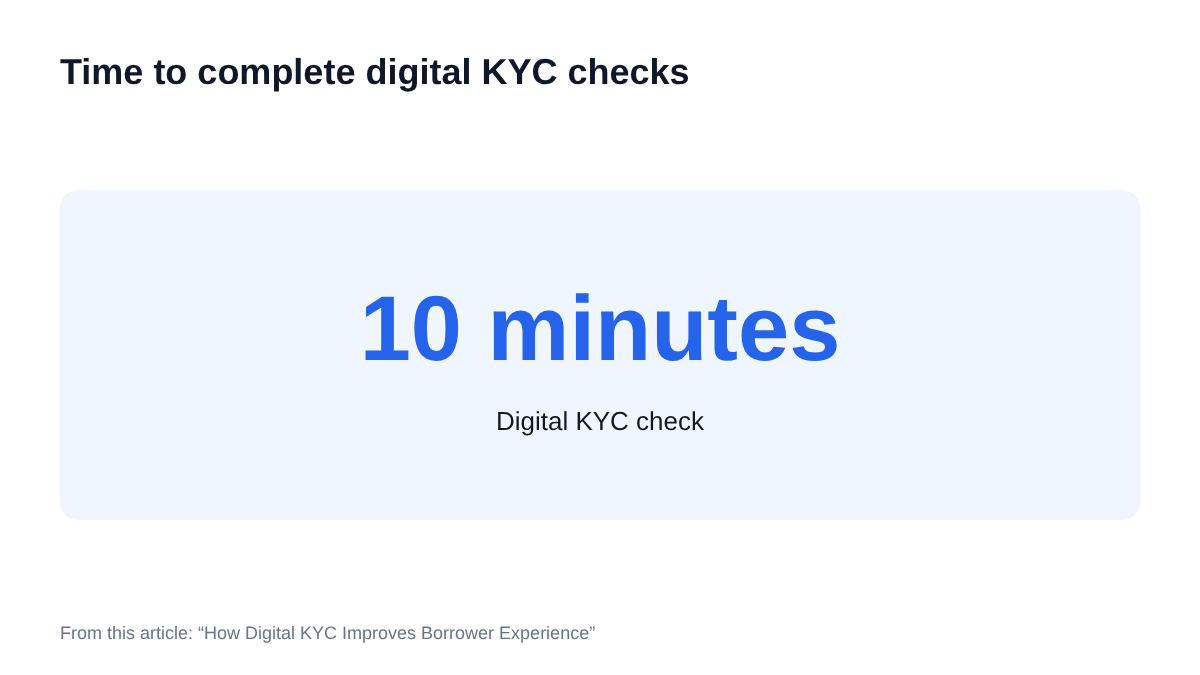
- Faster onboarding: Most digital KYC checks finish in under 10 minutes.
- Fewer errors: Data is auto-extracted, reducing typos and lost paperwork.
- Remote access: Borrowers in rural or remote regions can complete checks from home.
- 24/7 availability: No need to visit a branch during business hours.
Accessibility and Inclusion Challenges
- Some older Australians or those with low digital literacy struggle with app-based checks.
- Identity documents must be current and readable – damaged or expired IDs can stall the process.
- People with complex names or non-Anglo backgrounds sometimes get flagged by automated systems. It’s not fair, but it happens.
Digital KYC and Fraud Prevention: What Actually Works?
Fraud in lending is a constant threat. Fake documents, identity theft, and synthetic IDs cost Australian lenders hundreds of millions annually. Digital KYC helps, but it’s not a silver bullet.
How Digital KYC Stops Fraud
- Real-time cross-checks: IDs are checked against government databases, making fakes easier to spot.
- Biometric verification: Selfies and video liveness tests make it hard to use stolen IDs.
- Machine learning: AI can flag unusual patterns, like many applications from the same device or IP.
- Ongoing screening: Watchlist checks keep running even after onboarding.
Weak Spots and Limitations
- Sophisticated fraudsters sometimes trick facial recognition with high-quality photos or deepfakes.
- Data breaches can expose sensitive information if platforms are not secured properly.
- False positives can frustrate genuine borrowers, especially those with less common names.
The tech keeps improving, but lenders still need human checks for edge cases.
Compliance Automation: Reducing the Burden on Lenders
Australian lending is tightly regulated. Manual compliance checks eat up time, cost money, and slow down the whole process. Digital KYC systems automate most of this work.
Key Features of Compliance Automation
- Instant reporting: Every check is logged and stamped with a date/time.
- Audit-ready trails: Regulators can see who did what, when, and why.
- Automatic risk scoring: Applicants are ranked by risk, so extra checks happen only where needed.
- Ongoing monitoring: Alerts trigger if a borrower’s risk profile changes later on.
Practical Impacts for Lenders
- Onboarding costs drop by 40 – 70% (industry estimates, 2023).
- Staff spend less time chasing paperwork and more time on complex cases.
- Fewer compliance breaches and regulatory fines.
For more on bottlenecks and process pain points, see Why Most Australian Lenders Still Struggle With Approval Bottlenecks.
Customer Onboarding: How Digital KYC Streamlines Lending
Getting a new borrower approved used to take days, sometimes weeks. Now, digital KYC lets lenders go from application to approval in under an hour for straightforward cases.
Typical Digital KYC Onboarding Process
- Borrower starts loan application online or in-app.
- System requests ID upload (passport, licence, or Medicare card).
- Borrower takes selfie or completes biometric check.
- System runs data checks and watchlist screening.
- Results are instantly sent to lender dashboard for review.
- Loan moves to approval stage or triggers extra checks if needed.
Benefits for Lenders
- More applications can be processed each day.
- Drop-off rates fall since fewer people abandon halfway.
- Lenders get a clear audit trail for every applicant.
Borrower Experience Improvements
- No need for physical visits.
- Clear instructions and support built into most platforms.
- Instant feedback if something is missing or unclear.
Regtech Solutions: Who’s Powering Digital KYC in Australia?
Dozens of regtech companies now offer digital KYC tools tailored for Australian lenders. Choosing the right partner matters, since not all platforms are equal.
Leading Digital KYC Providers
- FrankieOne: Integrates with over 350 data sources, widely used by neobanks and fintech lenders.
- IDVerse (formerly OCR Labs): Specialises in biometric and liveness checks, used by major banks.
- Australia Post Digital ID: Government-backed, trusted for high-stakes verification.
- GBG: Strong presence in global screening and anti-fraud tools.
What to Look For in a Regtech Platform
- Integration with Australian and international databases (DVS, passport, sanctions lists)
- Strong data security (ISO 27001 certification, encryption)
- Customisable risk scoring and workflow automation
- Local support and regular compliance updates
If a provider can’t explain their audit process or data protection measures, I’d skip them.
Reporting, Recordkeeping, and Audit Trails: Staying Compliant
Lenders must keep detailed records of every KYC check, audit trail, and decision for at least 7 years, as per AML/CTF rules. Digital KYC makes this much easier, but only if set up properly.
What Records Must Be Kept?
- Copy of each ID document checked
- Results of database and watchlist screenings
- Logs of who performed each action and when
- Notes on any exceptions or manual reviews
How Digital KYC Simplifies Reporting
- All records are stored digitally with timestamps.
- Reports can be generated for auditors or AUSTRAC on demand.
- No risk of paper records being lost or damaged.
Risks and Pitfalls
- Data retention policies must comply with Privacy Act 1988 (Cth).
- Over-retention or insecure storage can lead to privacy breaches.
- Regular audits are needed to ensure old records are deleted as required.
Common Mistakes and How to Avoid Them
Even with digital KYC, lenders still run into trouble. Here are the main traps and some easy fixes.
- Using outdated or non-compliant regtech platforms
- Failing to update risk models as fraud tactics evolve
- Ignoring accessibility for older or less tech-savvy borrowers
- Not training staff on exceptions handling
- Forgetting to purge old data as per privacy laws
Simple solution? Regular reviews, strong vendor contracts, and clear internal policies.
Practical Scenarios: Digital KYC in Action
Let’s look at two real-world scenarios to show how digital KYC impacts both lenders and borrowers.
Scenario 1: First-Home Buyer in Sydney
Priya applies online for her first home loan. She uploads her driver’s licence, takes a quick selfie, and the system verifies her identity against the DVS in under 5 minutes. Her application moves straight to credit assessment, and she gets conditional approval the same day. No branch visit, no waiting for certified copies.
Scenario 2: Small Business Owner in Perth
Liam owns a café and needs a short-term loan. The lender’s digital KYC platform screens his company’s directors against ASIC records and global watchlists. A minor mismatch triggers manual review, but the compliance officer quickly resolves it. Liam’s loan is approved in 24 hours, and all checks are logged for future audits.
Digital KYC and Data Security: What Borrowers Should Know
Borrowers often worry about where their data goes. Digital KYC systems handle sensitive details, so data security is not optional.
Data Protection Standards
- Encryption at rest and in transit (AES-256, TLS 1.2+)
- Regular penetration testing and vulnerability scans
- Compliance with Australian Privacy Principles (APPs)
What Borrowers Can Check
- Does the lender use a reputable regtech provider?
- Is there a clear privacy policy explaining data use and retention?
- Are there options to request deletion or correction of personal data?
If any of these are missing, ask questions or consider another lender.
Costs and ROI: Is Digital KYC Worth It for Lenders?
Implementing digital KYC isn’t free, but most Australian lenders see a clear return on investment (ROI).
Typical Costs
- Setup: AUD 10,000 – 50,000 for integration and training
- Per-check fee: AUD 2 – 8 (vs AUD 15 – 30 for manual)
- Ongoing: Subscription or usage-based pricing
Savings and Benefits
- 50 – 80% reduction in onboarding time
- Fewer compliance breaches and fines
- Lower fraud losses
- Higher customer satisfaction and retention
Over 3 – 5 years, the savings usually outweigh the upfront costs, especially for lenders handling more than 1,000 applications per month.
Future Trends: What’s Next for Digital KYC in Australian Lending?
The digital KYC space keeps shifting. Here’s what’s coming next:
- AI-driven risk scoring: More lenders use machine learning to spot complex fraud patterns.
- Open banking integration: Borrowers can share bank data directly, speeding up income and expense checks.
- Greater inclusion: New tools are being developed for people without standard IDs (e.g., Indigenous Australians, recent migrants).
- Continuous monitoring: Ongoing KYC checks, not just at onboarding.
Regulators are also increasing scrutiny, especially on data privacy and algorithmic bias. Lenders must keep updating their processes to stay compliant.
Frequently Asked Questions
What is digital KYC?
Digital KYC is an online process that verifies a person’s identity for financial services, using document uploads, biometric checks, and database screening instead of manual paperwork.
How does digital KYC help prevent fraud?
Digital KYC cross-checks IDs with government databases, uses facial recognition, and monitors for suspicious patterns. This makes it harder for fraudsters to use fake or stolen identities to access loans.
What are the compliance requirements for digital KYC in Australia?
Lenders must follow the AML/CTF Act, use approved data sources, keep records for at least 7 years, and report suspicious transactions to AUSTRAC. Ongoing monitoring and regular audits are required.
How long does digital KYC take for borrowers?
Most digital KYC checks take 2 – 15 minutes, depending on the platform and the quality of the documents submitted.
What happens if digital KYC fails or flags an issue?
If there’s a mismatch or a red flag, the application moves to manual review. Lenders may request more documents or a video call to resolve the issue.
What documents are accepted for digital KYC in Australian lending?
Commonly accepted documents include Australian passports, driver’s licences, and Medicare cards. These are verified against government registries.
Is digital KYC secure?
Most regtech providers use encryption, secure servers, and comply with Australian privacy laws. Borrowers should check the lender’s privacy policy and security certifications.
Can digital KYC be used for business loans?
Yes, digital KYC checks can verify both individuals and company directors, cross-checking with ASIC and business registries as required.
What are the penalties for non-compliance with digital KYC rules?
Penalties can include fines up to AUD 21 million per breach, loss of licence, and mandatory remediation. AUSTRAC regularly audits financial institutions.
How do lenders choose a digital KYC provider?
Lenders look for integration with official databases, strong security standards, local support, and regular compliance updates. Cost and ease of use are also important factors.
Are there any groups who struggle with digital KYC?
Yes, older Australians, people without standard ID documents, and those with limited digital skills may face challenges. Lenders should offer alternative verification options.
What are the benefits of digital KYC for borrowers?
Borrowers benefit from faster approvals, less paperwork, and the convenience of remote onboarding. Most can complete the process in minutes, at any time of day.
What Borrowers and Lenders Should Remember
Digital KYC has made borrowing in Australia faster, safer, and less frustrating. Lenders can meet strict compliance rules without drowning in paperwork, while borrowers enjoy quick, remote onboarding. But technology isn’t perfect – accessibility, privacy, and fraud risks still need attention. The best results come when digital KYC is paired with smart oversight and a focus on customer support.