

If you’ve ever stared at a Business Activity Statement, wondering if you’ve ticked every GST box or worried about a payroll tax notice from the ATO, you’re not alone. Many Australian business owners and finance teams feel the pressure – especially during tax season Australia – of getting GST compliance and payroll tax right. A small slip can mean big fines, lost time, or an audit letter you never wanted. It’s not just about filling forms; it’s about understanding what the ATO expects, what rules really apply, and how to avoid the most common traps.
Untangling GST and Payroll Compliance Issues in Australia
GST compliance in Australia means registering for GST if your turnover exceeds $75,000, charging and collecting GST on taxable sales, lodging accurate BAS on time, and keeping detailed records. Payroll tax applies separately and is state-based, with thresholds varying by state. The biggest compliance pitfalls include missing GST registration, incorrect BAS lodgement, miscalculating payroll tax, and incomplete ATO payroll reporting. Staying compliant requires understanding your obligations, using up-to-date payroll and accounting systems, and checking for changes in GST and payroll tax thresholds annually.
Why GST and Payroll Compliance Trips Up Australian Businesses
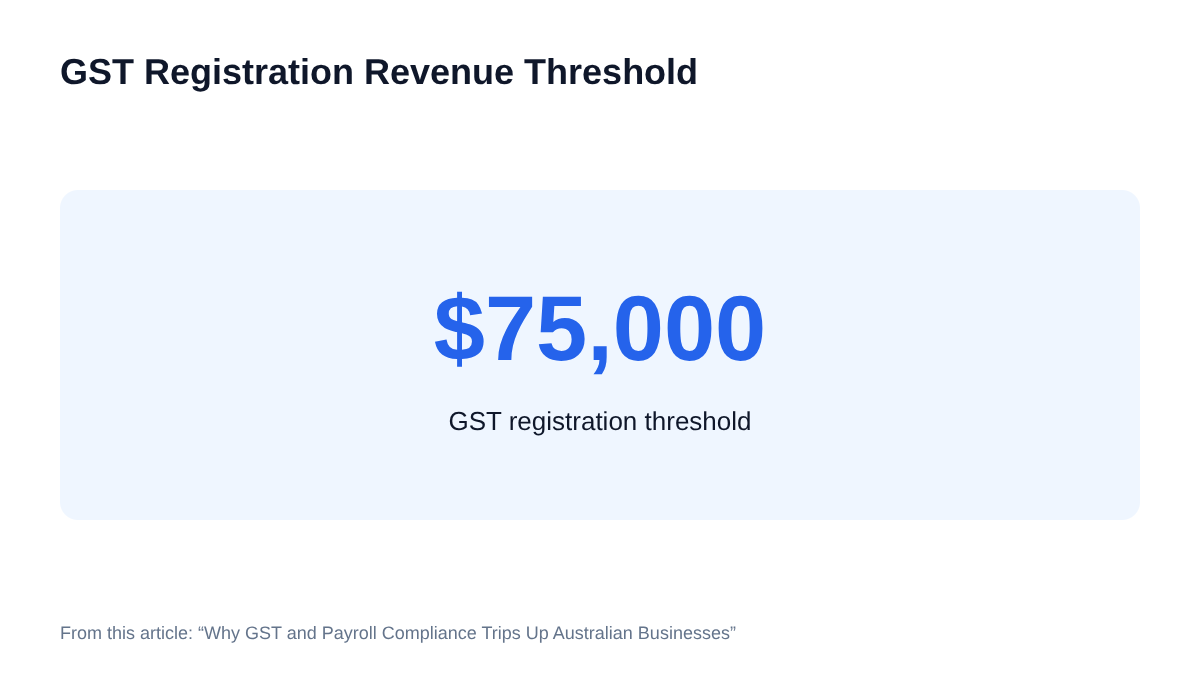
GST and payroll tax aren’t just paperwork – they directly affect cash flow, business risk, and trust with the ATO. A simple error, like forgetting to register for GST when your revenue crosses $75,000, can trigger backdated tax bills plus penalties. Miss the payroll tax threshold in your state and you might underpay, risking fines or even prosecution.
The rules change often. The ATO updates reporting standards, states tweak payroll tax thresholds, and even the smallest business can get flagged for an ATO audit. Most compliance problems come from:
- Not knowing when GST registration is mandatory
- Misclassifying taxable vs GST-free sales
- Confusing payroll tax rules across different states
- Late or incorrect BAS lodgement
- Missing Single Touch Payroll (STP) reports
If you think, “Surely my accountant will catch it,” – honestly, many owners only find out after a letter from the ATO. It’s worth understanding the basics yourself.
GST Compliance Australia: What You Need to Know
GST (Goods and Services Tax) is a 10% tax on most goods and services sold or consumed in Australia. The rules seem simple, but the details trip up many businesses.

GST Registration: Who Must Register?
You must register for GST if:
- Your business or enterprise has a GST turnover of $75,000 or more (non-profits: $150,000)
- You provide taxi or ride-sourcing services (Uber, Ola, etc.), regardless of turnover
- You want to claim fuel tax credits
Failing to register on time can mean:
- Backdated GST owed on all taxable sales from when you should’ve registered
- Interest and penalties (sometimes over 20% p.a.)
Tip: Check your turnover every month. If you expect to cross $75,000 in the next 12 months, you must register. Don’t wait for the ATO to ask.
Charging GST Correctly
Once registered, you must:
- Add 10% GST to taxable goods and services
- Issue tax invoices with your ABN and GST amount clearly shown
- Exclude GST from GST-free or input-taxed items (e.g., basic food, some health services, residential rent)
BAS Lodgement: Reporting and Paying GST
The Business Activity Statement (BAS) is how you report and pay GST (plus PAYG and other taxes). Most small businesses lodge quarterly, but larger ones may lodge monthly. Key BAS lodgement requirements:
- Lodge by the 28th day after the end of each quarter (or 21st for monthly lodgers)
- Report total sales, GST collected, GST paid on purchases, and calculate your net GST liability
- Pay any GST owed by the due date
Late BAS lodgement can trigger penalties starting at $313 per 28 days (as of 2024), plus interest. Repeated late lodgement increases your audit risk.
Claiming GST Credits
You can claim GST credits (input tax credits) for GST paid on business expenses, but only if:
- You have a valid tax invoice
- The purchase is for your business (not private use)
- The supplier is registered for GST
Common mistakes include claiming GST credits on:
- Entertainment expenses (often not allowed)
- Non-GST registered suppliers
- Private expenses
If in doubt, check with your accountant or the ATO.
Payroll Tax Australia: Rules, Thresholds, and Traps
Payroll tax is a state-based tax on wages paid by employers. Unlike GST, payroll tax thresholds and rates differ in each state and territory. This causes confusion, especially for businesses with staff in more than one state.
Payroll Tax Thresholds and Rates by State (2024)
Below is a summary of current payroll tax thresholds and rates for major states. Always check your state revenue office for the latest figures. StateThreshold (per year)Rate (above threshold)NSW$1.2 million5.45%VIC$700,0004.85% (metro) / 1.2125% (regional)QLD$1.3 million4.75% up to $6.5m, 4.95% overWA$1 million5.5%SA$1.5 million4.95%TAS$1.25 million4.0%ACT$2 million6.85%NT$1.5 million5.5% Note: Thresholds and rates can change mid-year. Always check your state revenue website before calculating.
What Wages Count for Payroll Tax?
Payroll tax applies to:
- Salaries, wages, and allowances
- Superannuation contributions
- Bonuses and commissions
- Payments to contractors (in many cases)
- Fringe benefits
Some payments, like parental leave or redundancy, may be exempt, but rules are strict. Misclassifying contractors is a common mistake – the ATO and state offices check this closely.
Payroll Tax Grouping Rules
If you own or control multiple businesses, state revenue offices may group them together for payroll tax. This means the threshold applies to the total wages of all grouped businesses, not each one separately. Failing to declare grouped businesses can lead to backdated payroll tax, interest, and penalties.
ATO Payroll Reporting: BAS, STP, and Common Errors
Accurate payroll reporting is mandatory, and the ATO cross-checks data from many sources. The two main requirements are BAS reporting and Single Touch Payroll (STP).
BAS Reporting for Payroll
On your BAS, you must report:
- PAYG withholding amounts (tax withheld from employees)
- Superannuation guarantee contributions (not paid via BAS, but checked against PAYG)
- Fringe benefits tax (FBT) if applicable
Incorrect reporting or late BAS lodgement can trigger penalties and raise red flags for ATO audits.
Single Touch Payroll (STP)
STP is a system where payroll data is sent directly to the ATO every pay run. It covers:
- Employee salaries and wages
- PAYG withholding
- Superannuation paid
STP is mandatory for all employers. Failing to report through STP can lead to:
- Fines ($210 per employee per missed report, as of 2024)
- Delayed employee tax refunds
- Increased audit risk
Common Payroll Reporting Mistakes
- Not reconciling payroll software with BAS and STP reports
- Missing employees or contractors from reporting
- Incorrect superannuation calculations
- Not updating pay rates after awards change
BAS Lodgement: Timing, Process, and Tips
BAS (Business Activity Statement) is the ATO’s main tool for GST and payroll tax collection. Many compliance headaches come from late or incorrect BAS lodgement.
BAS Lodgement Frequency
Your BAS lodgement frequency depends on your GST turnover:
- Less than $20 million: Quarterly (default)
- More than $20 million: Monthly
- Some can choose annual BAS if turnover is under $75,000
BAS Lodgement Steps
- Gather all tax invoices and receipts
- Calculate total sales, GST collected, and GST paid on purchases
- Complete BAS form (online via ATO portal or through your accountant)
- Lodge BAS by the due date
- Pay any GST or PAYG amounts owed
Late lodgement triggers penalties and interest. If you can’t pay on time, contact the ATO to set up a payment plan – waiting only increases risk.
BAS Lodgement Tips
- Set calendar reminders 2 weeks before due dates
- Use accounting software that integrates with ATO systems
- Double-check figures against your bank statements
- Review GST-free and input-taxed sales carefully
ATO Audits: Triggers, Risks, and How to Prepare
ATO audits can happen to any business, not just large companies or tax evaders. Audits often follow patterns – late BAS lodgement, inconsistent GST reporting, or mismatched payroll data.
Common ATO Audit Triggers
- Repeated late or amended BAS
- GST claims that are much higher or lower than industry averages
- PAYG withholding not matching STP or employee records
- Large refunds or credits claimed without explanation
- Anonymous tip-offs or data matching with state payroll tax offices
Audit Process: What to Expect
- ATO will contact you by letter, phone, or through your tax agent
- You’ll be asked to provide supporting documents (invoices, payroll records, bank statements)
- The ATO may visit your premises or conduct a desk audit
- If errors are found, you’ll receive an amended assessment and may owe extra tax, interest, and penalties
Tip: Keep all records (GST, payroll, super, contracts) for at least 5 years. Electronic backups are fine if clearly legible.
Reducing Audit Risk
- Lodge BAS and payroll reports on time, every time
- Reconcile GST and payroll figures across all reports
- Fix errors as soon as you spot them – voluntary disclosure can reduce penalties
- Don’t ignore ATO correspondence
Common GST and Payroll Compliance Pitfalls (and How to Avoid Them)
Mistakes can be costly, but most are avoidable with the right checks. Here are the most frequent compliance errors:
- Not registering for GST when required
- Charging GST on GST-free items (like basic food or education)
- Claiming GST credits on private or non-deductible expenses
- Missing payroll tax registration after crossing state thresholds
- Failing to group related businesses for payroll tax
- Late or missing BAS lodgement
- Not updating payroll systems after ATO rule changes
- Underpaying superannuation or not reporting via STP
How to avoid:
- Review GST and payroll tax thresholds at least yearly
- Use up-to-date accounting software
- Cross-check all reports before lodging
- Train staff on GST and payroll basics
- Consult a registered tax agent for complex issues
Special Cases: Contractors, Fringe Benefits, and Industry-Specific Issues
Some industries and payment types add extra complexity to GST compliance Australia and payroll tax Australia.
Contractors and Payroll Tax
Payments to contractors are often caught by payroll tax if:
- The contractor mainly works for you
- You supply tools, uniforms, or control their work
- The contract is mostly for labour, not materials
Each state applies its own tests, but most err on the side of including contractors. Review contracts annually.
Fringe Benefits Tax (FBT)
FBT applies if you provide non-cash benefits to staff (cars, gym memberships, loans, etc.). FBT is separate from GST and payroll tax, but must be reported on BAS and annual FBT returns. Missed FBT can trigger ATO audits.
Industry-Specific GST Rules
- Medical and health: Many services are GST-free, but not all. Check ATO rulings for allied health, cosmetic, and alternative therapies.
- Construction: Progress payments, retention amounts, and margin schemes can complicate GST.
- Education and childcare: Most fees are GST-free, but some extras (excursions, food) may attract GST.
Compliance Systems and Technology: Getting It Right
Manual spreadsheets rarely cut it anymore. Modern compliance needs good systems.
Choosing Payroll and Accounting Software
Look for features like:
- ATO-certified Single Touch Payroll (STP) integration
- Automated BAS calculation and reminders
- Payroll tax calculators by state
- Secure electronic records storage
- Regular updates for tax law changes
Integrating with the ATO
Most cloud accounting platforms (Xero, MYOB, QuickBooks) let you lodge BAS and payroll reports directly to the ATO. This reduces errors and speeds up compliance.
Training and Internal Controls
- Train finance staff on GST and payroll rules
- Set up internal checklists for BAS and payroll tax
- Review compliance quarterly, not just at tax season
Penalties, Deadlines, and What Happens If You Get It Wrong
ATO and state revenue offices don’t go easy on repeat offenders or major mistakes. Here’s what you risk:
- Failure to register for GST: Backdated GST plus interest (up to 20% p.a.) and penalties (up to 75% of tax owed for reckless disregard)
- Late BAS lodgement: $313 per 28 days late, up to $1,565 for large businesses
- Incorrect GST or payroll tax reporting: Shortfall penalties from 25% to 75% of underpaid amount
- Superannuation underpayment: Superannuation Guarantee Charge (SGC), admin fees, and loss of tax deductions
If you realise you’ve made a mistake, disclose it to the ATO or your state revenue office as soon as possible. Voluntary disclosure can cut penalties in half or more.
Best Practices for Staying Compliant Year-Round
Compliance isn’t just a tax season Australia issue. The most successful businesses build checks into their regular processes.
- Monitor turnover and payroll monthly to catch threshold changes
- Reconcile GST, PAYG, and super after every pay run
- Use two-person sign-off for BAS and payroll tax lodgement
- Keep digital copies of all invoices and payroll records
- Set reminders for all key ATO and state deadlines
- Schedule an annual review with a registered tax agent
Frequently Asked Questions
What is GST compliance in Australia?
GST compliance in Australia means registering for GST if your turnover exceeds $75,000, charging GST on all taxable sales, issuing correct tax invoices, lodging BAS on time, and keeping accurate records. Non-compliance can result in penalties and interest from the ATO.
When do I need to register for GST?
You must register for GST when your business turnover is $75,000 or more in any 12-month period, or if you provide taxi or ride-sourcing services regardless of turnover. It’s best to register as soon as you expect to cross the threshold.
What are the payroll tax thresholds in Australia?
Payroll tax thresholds vary by state, ranging from $700,000 in Victoria to $2 million in the ACT (2024 figures). Check your state revenue office for the latest thresholds and rates. If you operate in multiple states, you may need to register in each state where you exceed the threshold.
How do I lodge a BAS?
To lodge a BAS:
- Collect all relevant invoices and receipts.
- Calculate GST collected and paid, PAYG withholding, and other taxes.
- Complete the BAS form (online or paper).
- Lodge with the ATO by the due date.
- Pay any tax owed. Using accounting software can simplify this process.
What triggers an ATO audit?
Common triggers include repeated late or amended BAS, large GST refunds, discrepancies between BAS and STP reports, and tip-offs. Mismatches in payroll tax or superannuation reporting can also prompt an audit.
What is Single Touch Payroll (STP)?
STP is a mandatory ATO system where employers report payroll information (wages, PAYG, super) every pay run. It ensures real-time reporting and helps the ATO match payroll, tax, and super data.
Can contractors be subject to payroll tax?
Yes, many contractor payments are included in payroll tax if the contractor mainly works for your business or the contract is primarily for labour. Each state applies specific tests. Review your contractor arrangements yearly.
What are the penalties for late BAS lodgement?
The ATO charges a Failure to Lodge (FTL) penalty starting at $313 per 28 days late (as of 2024), up to a maximum of $1,565 for large businesses. Interest and additional penalties may apply for repeated or serious breaches.
How do I claim GST credits?
You can claim GST credits if you have a valid tax invoice, the expense is for business use, and the supplier is GST-registered. Don’t claim credits on private or GST-free expenses.
What records should I keep for GST and payroll tax compliance?
Keep tax invoices, payroll records, BAS forms, superannuation records, and contractor agreements for at least 5 years. Electronic copies are acceptable if clearly legible and accessible.
When should I seek professional advice for GST or payroll tax?
Seek advice if your business crosses GST or payroll tax thresholds, operates in multiple states, hires contractors, or faces an ATO audit. Registered tax agents can help you avoid costly mistakes.
How do I fix a GST or payroll reporting mistake?
Correct errors as soon as possible by amending your BAS or payroll reports. Notify the ATO or your state tax office. Voluntary disclosure can reduce penalties and interest.
Staying Ahead of GST and Payroll Compliance
Getting GST compliance Australia and payroll tax right isn’t about luck. It’s about knowing the rules, keeping good records, and acting quickly when things change. Mistakes can be costly, but regular checks, quality software, and timely advice make a big difference. If you’re ever unsure, it’s safer to double-check with a registered tax professional than to risk an ATO audit or penalty.